


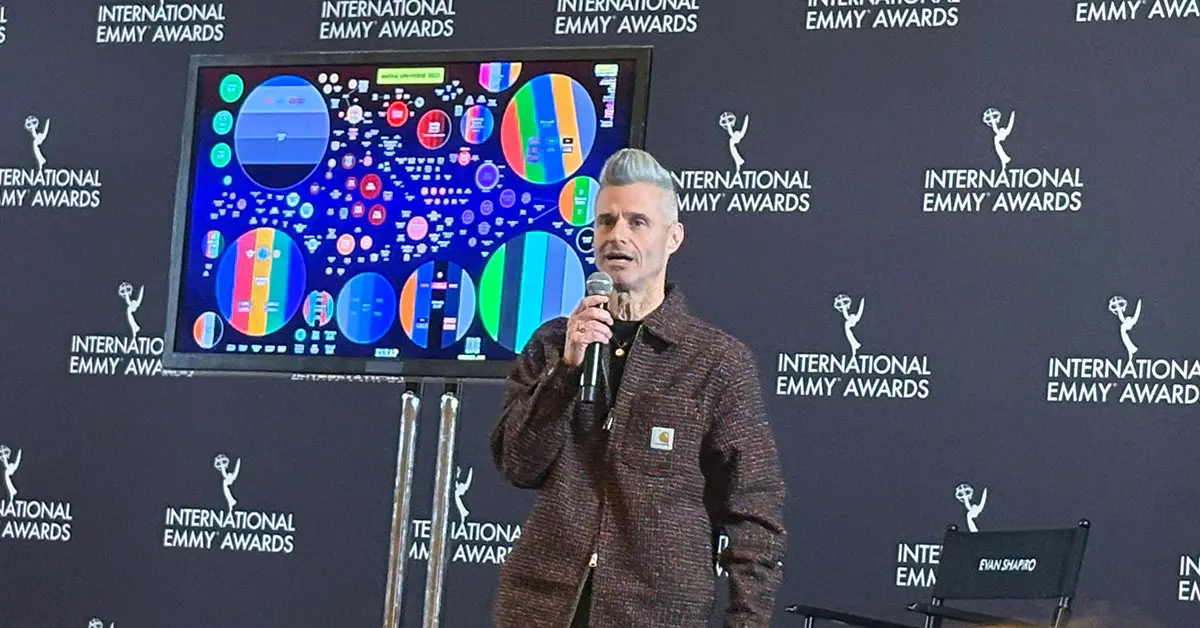
A highlight of the activities around the International Emmy Awards last week included a brilliant presentation by media cartographer Evan Shapiro about the pitfalls of not engaging with the social video universe as content companies and platforms look to grow their audiences today.
Shapiro delivered his presentation, which included his latest media universe map, to International Academy members on the morning of last week’s International Emmy Awards. If you’re not following Evan via his Media War & Peace newsletter and The Media Odyssey podcast with Marion Ranchet, you’re missing out.
Shapiro started producing his media universe map in 2020. “One set of companies on this map has grown; another set of companies on this map has not,” Shapiro said of the intervening transformative five years in media. “When I first presented this map to the universe, I heard from a lot of people in the comments, ‘Why would you put the big tech companies next to us when they take profits from their tech and dabble in media at a loss to steal share from us. That’s not fair!’ This is the competitive landscape. The big tech companies, most of them, have at least doubled in size in the last five years. Meanwhile, most of the big media companies have either stayed the same size, shrunken, broken apart, or are in the process of breaking apart. That’s because most of the big media companies ignore the voice of their audience. They ignore the data that’s staring them right in the face.”
The big shift to D2C five years ago marked a new era in media, Shapiro said: the user-centric one. “We are in a period where the audience is in complete radical control of everything that they watch and consume. This is not, to quote someone I know, a push economy anymore. This is a pull economy. The consumer pulls to them when they want.”
Big media, he said, has been ignoring this key fact, Shapiro noted. “They don’t understand who their audience is, and they don’t look at their own media through the eyes of their audience.”
Two-thirds of the world’s population is under the age of 40, Shapiro said. Millennials, Gen A, and Gen Z “are the first generations to grow up with supercomputers in their pocket, on social media, where their friends didn’t just see them at school but followed them home to their bedrooms at night. They don’t see the world differently. They live in a different world.”
And that’s 70 percent of the world, he said. “If you think you can talk to them and serve them the way you did their parents or their grandparents, you’re out of your minds…. These are the most important consumers on a moving-forward basis because they are going to control all of the spending.”
For any media company to thrive today, putting the audience at the center of its focus is key, Shapiro said. “You have to see the world through their eyes. The one unifying factor that blocks companies from transforming at the rate that they need to keep up with their audience is the fear of finding out. The fear of looking at inconvenient data, the fear of looking at facts that don’t agree with your worldview, the fear of understanding that the things you’ve always done are not going to work anymore.”
Citing data from Hub Entertainment Research, Shapiro noted that the average consumer now uses almost 14 unique media services, free and paid, across gaming, music, TV, and audio. “But less than half of them are must-have, un-cancellable services. That means more than half of the services that consumers now have are ready to be canceled with a little press of the thumb. In the past two years, the average consumer has cut back on half an hour of media per day.”
In the years since the pandemic high, consumers have been cutting back—specifically on TV services. “Yes, people will have Netflix. Yes, people will have Amazon. But the third and fourth slots are going to be a revolving door of services based on what show comes back that month. Canceling services has never been easier.”
Media companies have not adapted fast enough to the end of the pay-TV boom era, Shapiro explained. “They got to streaming way too late, and now are getting to social media way too late.”
Last year, the premium streaming ecosystem generated 174 million new subs—and lost 148 million. “We’ve given the consumer ultimate control, and they’re using it every single day.”
Shapiro went on to talk about audience fragmentation, citing data for the kinds of numbers a traditional TV show could once garner when there were just three broadcast networks and nothing else. “Broadcast is a shrinking ice cube, full of very old people.” YouTube, meanwhile, is up to a 13 percent share of all TV viewing in the U.S. “By July 2026, I believe that YouTube will have a larger audience just on television than all American broadcast networks combined. That’s where we’re headed.”
And YouTube is not all about short-form, viral videos, Shapiro stressed. “Long form content, a half hour or more, is now the vast majority of content watched on YouTube. Frontline puts every single episode, premium long-form documentary, up on YouTube the day after it premieres on PBS. They get at least, if not more, than twice the audience on YouTube than they do on PBS.”
YouTube is the only social video platform on TV right now; that will change soon, Shapiro said, so it’s best to get ready for that influx now.
Shapiro discussed this period of “radical disintermediation,” in which the top 20 percent of YouTube traffic is spread across a million channels. “Over the next 20 years, the three most important words in media will be fragmentation, fragmentation, fragmentation. Radical fragmentation. Infinite fragmentation. If you’re not comfortable with radical fragmentation, if you’re not comfortable with the competition that’s necessary within radical fragmentation, then this may no longer be the business for you because these are the new rules. When you understand these rules, when you pay attention to the voice of the audience, when you agree to obey the same rules that social video and the consumers who use them do, you can not just survive, you can dominate.”
In every market, YouTube is dominating in TV usage among millennials and the younger generation. “Millennials and younger live in a completely different ecosystem from the older generations. If you want to talk to 70% of the world’s population, growing every year, then you have to pay attention to the services that they use. Every single day, a billion hours of video are watched on YouTube on a TV. That doesn’t include phones, tablets, or laptops. That’s just television. The definition of premium has shifted in consumers’ minds. Your definition of premium doesn’t matter. Their definition of premium is premium.”
Creators “are the center of cultural gravity on the planet Earth,” Shapiro said. “One of the main reasons why creator economy platforms, social platforms are completely dominated by the creators is because big publishers have left those platforms exclusively to these creators. Creators have built empires out of it.”
Hollywood has now gotten that memo and is “scurrying to do their creative deals,” he said. “What we have here is an opportunity for mainstream media to adopt the rules of the creator economy and dominate it. But you have to understand that the rules are changing. You have to think about the content you make, the end user, and the experience you’re going to deliver. You have to diversify the slate programming you’re making. Test and learn ideas on social video. Use the data to educate yourself.”
Mainstream publishers are “reallocating cash,” Shapiro continued. “They’re spending the same amount of money on content, but they’re reallocating it, away from the things that make them special and towards the things that make them all look the same. The share of scripted programming of the total global spend on content has gone down, 10% in absolute terms, but 20% or more in total. Where is the money going? Sports, sports, sports, sports. Over the last couple of years, the amount spent on sports rights has gone up almost 300% and it’s not slowing down. These platforms are reallocating the money out of what made them special, what made them unique, and into a monoculture. It is dangerous for them. Meanwhile, the most interesting things that I watch, frankly, are on social video. Creators are the center of cultural gravity. But it doesn’t have to be that way. All the growth in the creator economy over the last decade has come from creators. Most of the growth in the creator economy in the next decade is going to come from big publishers finally getting the memo. When big publishers lean into the rules of the creator economy, they become the biggest creators on the planet. They earn new revenues by reaching new audiences.”
Shapiro referenced World of Wonder, creator of RuPaul’s Drag Race–Fenton Bailey was a guest on Shapiro’s aforementioned brilliant podcast with Ranchet—and quipped, “Be more like a drag queen. Be more scrappy. Be more nimble. Talk directly to your audience.”
Channel 4 has fully embraced YouTube: “viewership went up, and their revenue went up as well.” The case has been the same for CBC in Canada, which Shapiro also worked with on a YouTube strategy. Don’t fear cannibalization, Shapiro said—if you embrace YouTube, you’ll find a new audience, notably a younger audience.
“Most people find that this is an additive audience, generations younger than their television audience. And it generates brand-new revenues.”
Plus, Shapiro noted, “the fastest growing audience on social media right now is people over 50.”
Brands are following audiences to social, Shapiro continued. “When mainstream media and the creator economy meld into one, which is what’s happening right in front of our eyes. When the consumer picks up a screen and doesn’t see a difference between social video and premium SVOD, that’s the affinity economy, and we have to start measuring things differently than we did before,” Shapiro said.
“You can measure fandom in business terms,” he said. “Spotify and Netflix generate billions of dollars in earned media value every single year. Netflix spends a lot of money, but they’re also terrific at the social media game. Marketing is not content, but content is excellent marketing. This is how you measure fandom, how you measure passion.”
The end user has to be your primary focus as a content producer, Shapiro continued. “This is the affinity economy. Each business will have to learn about its audience individually, then build its audience around it. If you do, you can win in this affinity economy. Over the last five years, corporate media has grown at a CAGR of 3%. The affinity economy, as I call it, has grown at 25% per year over that same time. Corporate media is now going to go the other way. Which of these trains do you want to ride on? You don’t have to choose. This is not an either-or. This is not binary. This is a yes, and. You can do both. And if you do, you can find both pools of audience. There are two ecosystems existing in media consumption: millennials and younger; Gen X and older. You can cater to 100 percent of those two audiences if you put your users at the center of everything that you do. If you create a unified user strategy that includes all of the things your users like to do, you can do more than just survive in this user-centric era; you can thrive.”


