
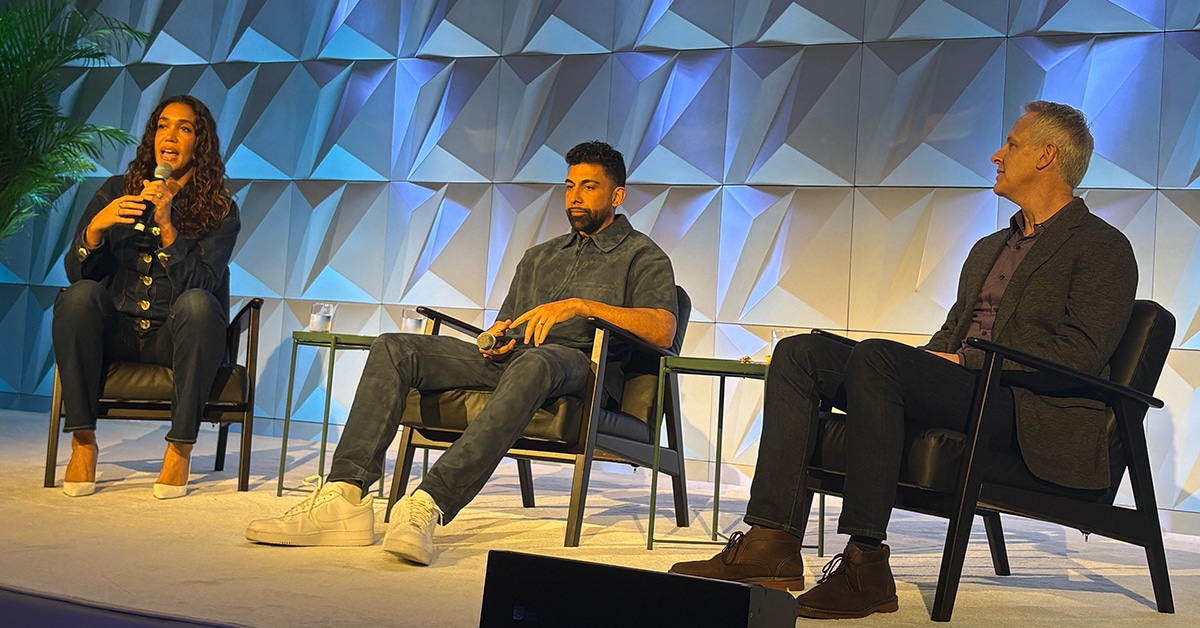
Dhar Mann and Sean Atkins shared with Realscreen Summit and NATPE Global delegates their strategy behind Dhar Mann Studios’ expansion off YouTube into FAST, vertical video, and more, and offered some tips on how to best engage with audiences on YouTube.
Dhar Mann Studios boasts more than 26 million subscribers on YouTube and produces a wealth of content from a 120,000-square-foot Burbank studio. Mann reminded attendees about his “humble beginnings.” Feeling like a failure at 30, and on the brink of eviction, Mann began recording videos from his living room apartment. For a while, his content received little to no engagement. “As I kept trying to iterate, I evolved formats. I went from talking on camera to writing scripts on napkins. I asked friends and family members to step in as actors, and my studio apartment became my production studio.”
Mann began creating 2- to 3-minute short films that “all taught some sort of positive life lesson. We stayed true to that mission. Eventually, it caught on. Now we have about nine full-time film crews. We have over 200 team members. We put out about 5 hours of scripted content every single week. So things have grown quite a bit, but it all started from a place of just trying to help people feel more connected and not alone.”
Atkins joined Dhar Mann Studios in 2024, having spent several years at legacy media companies like MTV and Discovery. Being in the creator economy calls for “a level of velocity,” he said, where you have to be “multimodal from day one. And it’s hard when you were trained to do one thing.”
The company now operates almost 90 YouTube channels, Atkins said. Shows are shot in days with small-scale crews.
For Mann, building the studio wasn’t the challenge—he needed expertise in areas like content syndication, OTT distribution, FAST platforms, and vertical video.
“Creators in general, we can only go so far,” Mann said. “There’s this conversation that’s happening that creators are eating traditional media players’ lunch. I don’t believe that whatsoever. I think that there’s this bridge, and the folks that can create the bridge between those two islands are the ones that are going to win in the long run.”
“The biggest change that I tell people from the traditional model is that development is gone,” Atkins said. “Because we can move so fast, because it’s so efficient, and because the creator owns their distribution and marketing, they’re fully vertically integrated, it’s much more cost-effective and efficient just to basically make it. We can always iterate to better. We can go from a notion to our main channel in 60 days at a normal pace, accelerated as fast as 14 days.”
The creator economy forces you into a “packaging-first” mentality, he added, given the importance of thumbnails and being able to immediately attract the interest of audiences.
Asked for the secret behind a perfect thumbnail, Mann said, “You have to create emotion, you have to create curiosity. Our test is: even without any text or context, you should have a good understanding of what the video is going to be and what you’re going to get. It’s not just about the packaging. Also, the first opening hook of the video should almost immediately deliver on whatever the promise of that packaging is.”
He continued, “When we’ve sat down with the Netflixes and the Disneys and such, someone said to me, it’s super important that within the first five minutes, we grab their attention. I’m used to five seconds! The packaging has to create intrigue and spark curiosity. Once you click it, then you have to deliver on the promise of that packaging immediately. Within the first 30 seconds, you have to overperform and give them something that they’re not even expecting. And you constantly have to do that about every minute and a half to 2 minutes. We call them retention hooks. You can call it curiosity gaps. You spark some sort of interest that doesn’t resolve unless you want to wait until the end to actually see how it plays out. When a lot of people think about packaging, they think about image, and they think about the title of the video. There’s this whole subconscious mind that you also have to think about, and that is what the name of the channel is. And then how many views the video has. As you consistently deliver to an audience and your videos get more views, if people see that your content has a lot of views, they’re naturally inclined to want to watch it. And then it’s also the age of the video. So those are the three subconscious parameters that also matter, that are somewhat part of the packaging, because it’s a first gatekeeper.”
Mann was recently named Chief Kindness Officer at the NFL as that massive sports league embraces the creator economy. “The way that legacy media companies and brands are embracing creators is completely changing,” Mann said. “What we meet with brands, a lot of them are saying, we’re not just interested in working with creators now. We actually have mandates in working with creators. The way that brands are approaching creators and having them a part of their storytelling in authentic ways.”
He added, “The real magic is when creators can work with platforms, can work with studios, can work with brands, and we all figure out ways to bring in our audiences together and get them excited about something much bigger.”