



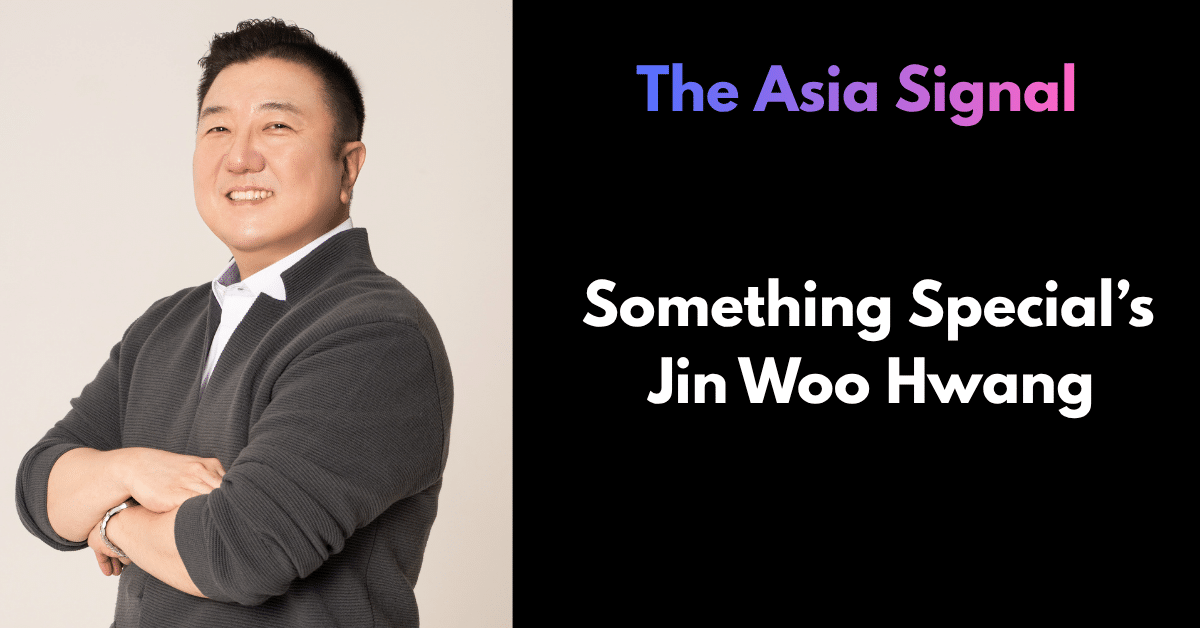
Jin Woo Hwang, co-founder, CEO, and EP at Something Special, shares with ScreenMDM insights on the Korean format export sector.
South Korea remains a vital hub for creativity, but its format export sector has slowed since the peak days of The Masked Singer and I Can See Your Voice. At BCWW in September, Trang Nguyen, APAC and MEA manager at K7 Media, said that Korea’s market share peaked in 2022, coinciding with the global boom in Korean music game shows, and has slipped since then. Hwang offers ScreenMDM some insights into what’s happening domestically and why he’s still betting on Korean innovation in scripted and nonscripted entertainment.
How do you see the health of the Korean format sector right now?
The Korean format industry is at a critical moment. On one side, the whole industry is heavily influenced by international streaming platforms. But on the other hand, television is losing more and more viewers, and its ad revenue has been declining faster than expected. This year and next are very important for the Korean format industry.
Linear platforms are struggling more than ever. Big-budget, high-concept, differentiated types of shows no longer appear on linear television. They are on the global streamers. That is very concerning. Local broadcasters keep testing [ideas] that you have already seen: celebrities visiting restaurants, travelogue shows, or sometimes studio talk shows. They’re similar shows you’ve experienced before. Global streamers have a completely new approach. They provide Korean shows with a scale that Korean television has never seen before. That is actually driving more audiences to international streamers than to local platforms or broadcasters. That is concerning not only for the broadcasters or production companies. The Korean government is very much concerned at the moment.
You have had success with new concepts. Tell us about Unforgettable Duet. You have a spin-off now, don’t you?
Rather than a spin-off, Suspicious Guesthouse: An Unforgettable Trip was a new approach that we learned from Unforgettable Duet. It is from the Unforgettable universe. This is a new approach to how we should think about dementia, which is a universal problem.
If you see Unforgettable Duet, it’s not a high-budget, big-scale show. We have fantastic paper-format ideas that have ultra-scale sets, beautiful mechanisms, and never-before-seen structures. However, that is very difficult unless it’s being commissioned by international streamers. So we thought it had to be a very high concept, which we call heartfelt creativity with a purpose, and contain culturally transferable mechanics. It’s very emotional, but also very uneasy and somewhat difficult to produce. But when we had the idea as a paper format and introduced it to international buyers, it was one of the most highly anticipated formats among the international buyers. Everyone said, “Is this possible? Would this really be adaptable into a television show?” And that’s why we invested in our production. It had great expectations from the international buyers. The ratings are great. It has doubled the commercial success of last year. Our job now is to take the show much further as a format.
What do you look for in IPs to represent?
On one hand, we develop and produce our own original formats, but that is also somewhat risky, and it’s not easy; it takes time and a lot of money. Great friends, legends like Avi Armoza and Jan Salling, gave me a great tip: you need more than 50 percent of your catalog to be filled with ideas that are already being produced and can be commercialized. More than half of our catalog isn’t ours; it’s from Korean broadcasters, production companies, or even creative talents. We have a seat at the table with global buyers. And global buyers always provide trends and needs. It is our job to provide and discover what the buyers need. And many Korean shows are yet to be discovered. The biggest problem with Korean formats is that supply still doesn’t match demand. Demand is higher, but supply is too low. Sometimes we find ourselves on a mission to give Korean ideas a chance to become a global franchise.
What are you hearing from the market? And how have you used those insights to craft your upcoming slate of formats for the rest of this year and into next?
There’s a huge appetite for studio, general-audience shows. There are some territories where I hear linear television is coming back, and there are also high expectations for smaller-budget shows or high concepts. It is our job to curate and discover shows that meet what international buyers truly need. Our recent format, From Unknown to Legend, shows us the kind of shows international buyers and broadcasters are seeking. People are asking for studio singing shows. There were some very different Korean singing shows. The two singing shows that looked quite different were From Unknown to Legend and The Scout. From Unknown to Legend is a big-budget show, but it’s much more comedic and entertainment-friendly, with a pyramid mechanic and a guessing-game element. It was a completely different take compared to other K-pop edition-type shows, where it’s too serious, or it’s too genuine, or too focused on the authenticity of becoming an idol. From Unknown to Legend is very easy-going. It’s family-friendly, entertaining, and enjoyable. One of the best ways to find out what the atmosphere of the show is to watch the audience and the production team. If they smile, if they enjoy it all at the same time, then there is a good chance the show will become a success.
What are your big priorities for 2027?
Everyone is in survival mode, especially indies or production companies in Korea. I’ve seen so many production companies fall just this year. In 2027, the most important thing is survival, and distribution and licensing of your formats is vital. Great support from the original rights holder is critical. You have to stay in conversation with them and stay connected not only to the buyers but also to the production team. Nowadays, some format-buying production companies don’t want flying producers or production consultants. It’s not free! We need to keep providing what is really needed for local adaptation. One of my great experiences was with Banijay when I was doing the Korean version of MasterChef. The flying producer, the consultancy methodology he provided, the experiences, the knowledge, the materials—that was one of the best moments, and it’s a perfect example of how production consultancy would be executed. That knowledge is so valuable and priceless that it actually enables local producers and helps provide great support for reproducing the original format. My global international standard has always been to become like him. That’s why we try to provide better materials than any other Asian or Korean companies, better consultancy, and a much more effective experience for our clients and partners.