


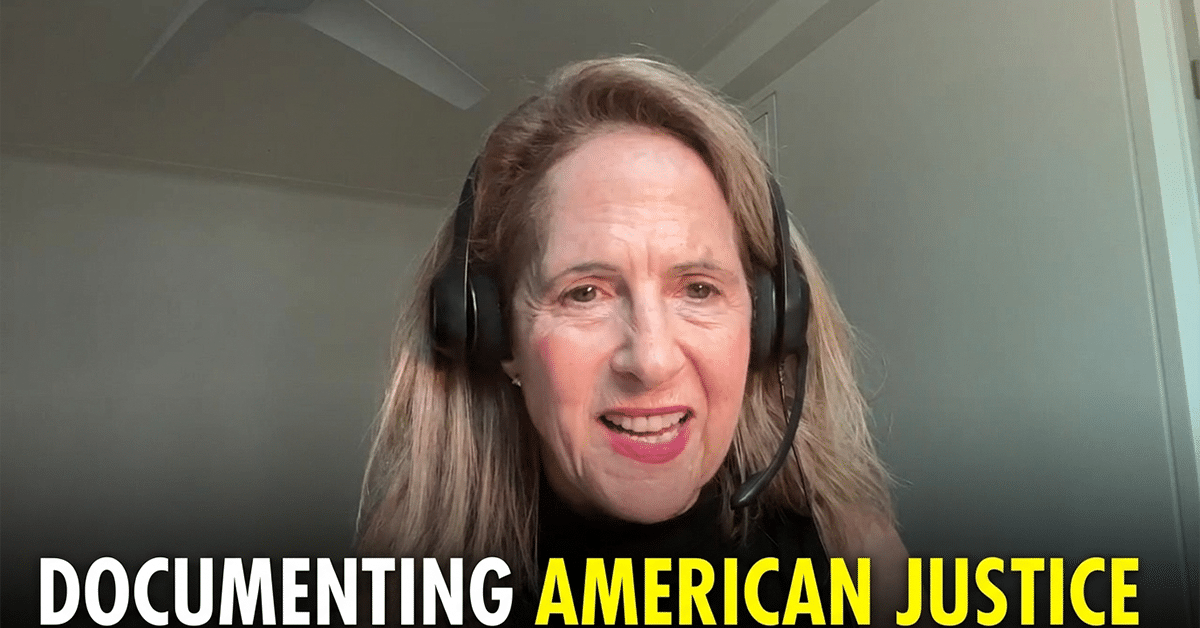
Acclaimed documentary filmmaker Lynn Novick joins ScreenMDM Talks’ Real Talk strand to discuss her upcoming PBS documentary series, Crime and Punishment in America, which condenses more than 200 years of U.S. justice into an eight-hour series that PBS Distribution is bringing to the global market at MIPCOM.
Over four parts, the epic series, set to air on PBS this November, explores the history of criminal justice in America, from pre-colonial times through the emergence of the modern penitentiary system to 21st-century mass incarceration. But this isn’t just a story of institutions; it’s an exploration of how race, class, power dynamics, and legislation have shaped the American experience.

A Skiff Mountain Films Production, in partnership with Florentine Films and WETA Washington, D.C., the series is directed by Novick—whose long list of credits includes The Vietnam War, Hemingway, College Behind Bars, and The U.S. and the Holocaust—with longtime collaborators Ken Burns and Sam Pollard as EPs.
The conversation with Novick is accessible on YouTube, Spotify, and Apple Podcasts.
Novick’s interest in the American justice system was sparked by her 2019 four-part series College Behind Bars, about inmates at the Bard Prison Initiative, which provides a college education to incarcerated individuals. “The more time I spent in the prisons and meeting people who were confined there and coming home, the more I realized how little I knew about this history. These institutions are at the core of who we are in some ways, and yet we never learn about them. They’re literally walled off from the rest of us. And as Bryan Stevenson, the great human rights attorney, says, it’s incumbent upon all of us to gain proximity to these systems and to understand how they operate. That drove us to take on this monumental task of making a documentary series about the history of crime and punishment in America.”
It was an ambitious undertaking, Novick concedes, beginning in pre-colonial times with indigenous communities. “We wanted to understand what happened on this continent before Europeans and enslaved Africans arrived here. And we work our way through the history up until today. It’s a very simple question—how did we get here?—with a very complicated answer.”
Complicated by history, inequality, and differing laws across the country. “We have 50 states, we have 3,000 counties, we have 19,000 police departments, we have this fragmented group of things that happen to create laws and enforce them. But there’s no one way to understand it, and there’s no one way to fix it.”
The creation of the penitentiary system marked a key turning point—and a revelatory one for the team working on the series. “People who were very forward-thinking and progressive felt that our system of brutal public punishment and executing people for relatively minor crimes was inhumane and wrong and ineffective and undermined faith in the justice system and caused people to misbehave in other ways. So we needed a solution, an alternative. And the solution they came up with was to build a place they called a penitentiary where people could be put for a period of time to have some time to themselves, to think, reflect, and repent. And then they would be released and come out into the world better than they went in. I don’t want to say that was the dream, but that was the vision of what a prison should be and could be. That was an American invention. A lot of other countries adopted it pretty quickly. It has very serious problems in its conception. But we haven’t come up with anything else in more than 200 years. So I just think we have to go back to the beginning and ask the question: why do we do what we do? Who benefits and who is harmed? Is this system that we have bringing us to a more just place? It’s a complicated question with many different answers over time, but that doesn’t change the fact that harm happens, and we have to do something about it. We have to balance the need for fairness and equality and justice with the need for people who have been harmed to feel that their voices are heard and that their rights are respected too.”
The series explores major structural developments but, at its core, focuses on human stories—victims of crime and the justice system, law enforcement, activists, and reformers. “Those voices are incredibly important to our story,” Novick explains. “And there are some real heroes here. People who are resilient and have enormously big hearts and compassion for the world and want to make it better, and people who’ve done wrong and want to make up for it. Hearing those voices and bringing them to life was incredibly important for us.”
Among the doc’s many sources was The Life and the Adventures of a Haunted Convict, penned by Austin Reed and considered the first memoir of incarceration by an African American. “That’s an incredible account of what it was like to be in prison in New York State in the 1840s and 1850s,” Novick said. “And we were able to get Samuel L. Jackson to read his voice and really bring him to life for us in the film.”
The filmmakers chose not to use AI reenactments across the series, with Novick noting that finding creative solutions for bringing history to life was a joy for the team. “There are no photographs of Austin Reed. We have his words written on the page—it is amazing to see his handwriting—but you don’t know what he looked like. We had to think about using a silhouette or filming someone from behind and imagining what he looked like. The creative energy that we put into solving those kinds of problems is what makes the film really exciting and fun to work on. I have to give big props to our editors, Dave Marcus and Ashwin Gandbhir, for incredibly creative solutions to these kinds of problems.”
AI could have made the process easier, she said, “but we see it as a slippery slope of what is the truth and what is real. And once you start, it’s hard to know where that line is. I couldn’t understand how we could make a film that we call a documentary and use AI to do it. Once we start creating material, I think we’re in a whole other category of something that I would not call a documentary.”
With PBS Distribution introducing the series to buyers—it was previewed at the London TV Screenings and is a key part of the company’s MIPCOM lineup—Novick is excited to see how international audiences will respond.
“It’s very much an American story, but it’s also a universal human story. We as viewers and filmmakers are wrestling with really profound questions about the human condition. Why do people commit crimes? Why do we punish people? How do we achieve justice? How does the way that society is organized affect all those questions? And that’s not unique to America by any means. There’s so much symbiosis between our justice system and many other countries and a lot of cross-pollination in a way. So, understanding how what we do influences other nations and vice versa is really important. And you’ll get to know some extraordinary people. Viewers will gain a deeper understanding of the American story and their own stories because one of the things the film does is ask all of us, What would we do if something like this happened to us? And that’s not unique to America at all.”
Novick also weighed in on her long-running association with PBS. “I haven’t experienced what it’s like to try to make documentaries for any other platform or system,” she said. “I understand from colleagues who have done so that on a streaming platform you’re basically told after ten minutes something has to happen so people will stay tuned. We, as consumers, we’re aware of these very formulaic ways that content is structured so that you don’t turn it off and so that you hit next episode. There’s this algorithmic world that we’re all exposed to and influenced by: you like this, here are ten more things like that. It’s hard to resist, and it’s satisfying, like eating popcorn or a candy bar. It doesn’t stay with you. I can barely remember if I watch shows that are wallpaper.”
Novick remains encouraged that “there is a huge audience for more thoughtful, more carefully crafted, more deeply thought-out stories that are not telling you what you already know and not confirming what you already think, and giving the viewer a chance to ask questions and to dig deep and to be exposed to people and stories that they hadn’t come in contact with before and feel an intimate connection. We see this over and over again with all of our films. As much as the algorithmic true crime monster is out there, it’s not all there is. You have to work a little harder, perhaps, to seek out content that’s going to be more satisfying. Millions of people want to learn and be entertained, not manipulated, and to find something revelatory they can then discuss with family and friends. Our films really are about that, finding that space. And this project for sure. It asks a lot of questions. It doesn’t have that many answers.”


