
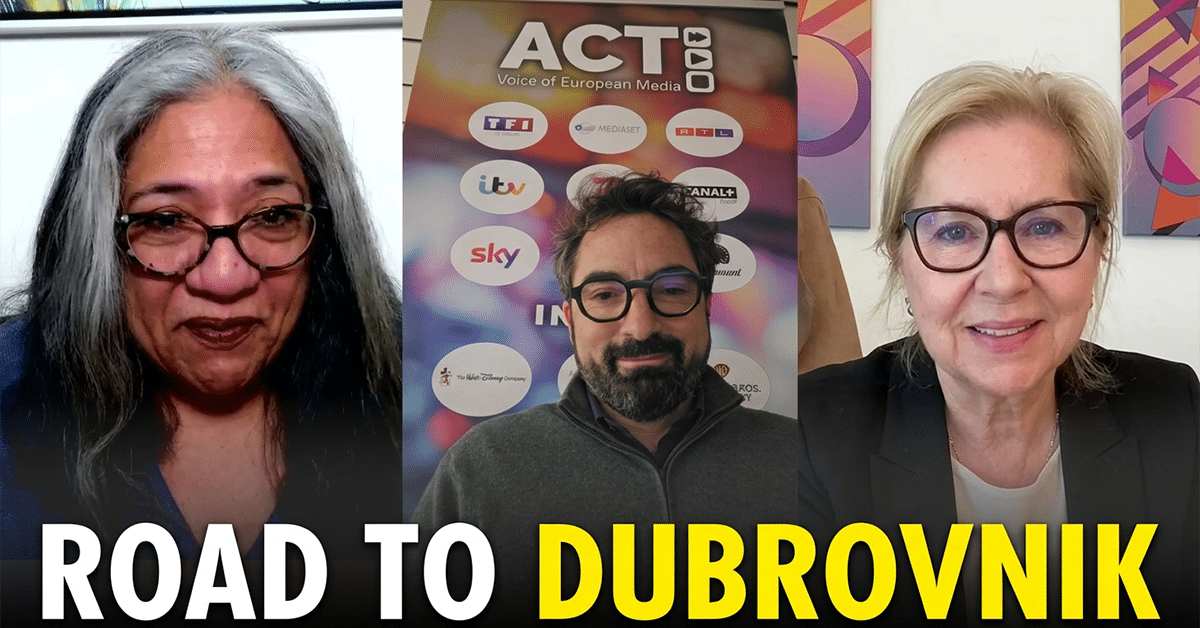
ScreenMDM Talks welcomes Sanja Božić-Ljubičić to share how NEM Dubrovnik has become the must-attend CEE market this summer, while ACT’s Grégoire Polad weighs in on how important the event is for convening thought leaders to discuss the transformation happening across Europe’s media ecosystem.
Božić-Ljubičić is the powerhouse behind Pickbox, Mediatranslations, MediaVision, and NEM. She had her event organizer hat on for this podcast about NEM Dubrovnik, happening June 8 to 11. Now in its 13th year, NEM Dubrovnik is set to be its biggest to date, with more than 200 CEE buyers and 150-plus exhibitors expected. It is also the last one standing in CEE this summer.
The journey here was filled “with a lot of love, a lot of support from friends from the industry, and me not being a corporation,” Božić-Ljubičić says in the podcast, which you can watch on YouTube below and on Spotify here.
Polad is the director general of the Association of Commercial Television and Video-on-Demand Services in Europe (ACT) and a frequent attendee of NEM. “When you’re in an industry like broadcasting, like video on demand, you are always subject to this silent partner in the room, which is the government. We’re in extremely regulated environments. Understanding how these trends may affect their business at the national and European levels is a key message to deliver. Where do these two parts, regulation and business, collide, and what can be done there?”
This year’s edition officially opens on the Monday afternoon with Three Media Trends, featuring Polad and Božić-Ljubičić alongside Christian Grece of the European Audiovisual Industry and Ampere Analysis’s Guy Bisson discussing new forms of collaboration, regional content investments, and consolidation.
“Everybody is doing their best to gain audiences, and in some cases just maintain an audience,” Polad says. “It’s a very competitive business out there. We’re all competing for eyeballs. There has been a serious impact from the emergence of YouTube, TikTok, and other players. All in an environment that’s quite unstable geopolitically and economically. So there is a need to spread risk by creating partnerships and co-produced content. Then, of course, you have the data revolution, which is completely impacting how the industry thinks about how it distributes, and also how it creates, what formats it creates, and what audiences are going to be receptive to those creations. Meanwhile, we’re trying to translate that to a legal framework, which is a lot of what we do at ACT. What can we do about monetizing these complex works that require a lot of upfront risk and money to be able to recoup that investment and continue reinvesting?”
Given that these platforms compete with content creators on YouTube who are luring audiences with much smaller budgets and operating in low- to minimally regulated environments, one of ACT’s mandates is to keep broadcasters’ relevance alive.
“That means putting forward what broadcasters are best at doing, which is creating real links with people. We continue to see that with live sports. We’re in a news-hungry world and broadcasters still help people get a broad sense of different viewpoints in an environment they can trust.”
For Božić-Ljubičić, the key issue is investment, or the lack of it. “It’s not a matter of talent or production. It’s just a matter of us not having enough funds to invest in something that would be recognized in Europe. I’m not sure that we have opened the wings towards great new heights. We haven’t.”
On the road ahead for European media, Polad expects more consolidation and hopes that European governments are coming to realize that there needs to be some regulatory change to help local media companies thrive against the global tech giants. Big tech controlling the narrative is not where audiences want to be, Polad stresses, “if they’re interested in having media pluralism and cultural diversity.”
Plus, Polad says, the media is not just another industry. “We’re not selling condos by the beach. We’re selling a societal model of democracy that rests on an essentially yin-and-yang of public and private. Public media must remain strong so private media can play their role as well. But it’s also important for the private media to remain there as the motor, because they are the largest driver of investment in national creation, and they will continue to be. We can talk all we want about subsidies; nobody’s disputing their role. But at the end of the day, if you don’t have private enterprise and diversity of private enterprise, you don’t have media pluralism.”
That recognition, Polad says, is creating “healthier discussion about media policy here at the EU level. What do we need to do not only to put money into the coffers of public service broadcasters, but also to facilitate the entry of new investors into our media sphere and national space, and not be as protective as we might have been in the past?”


