


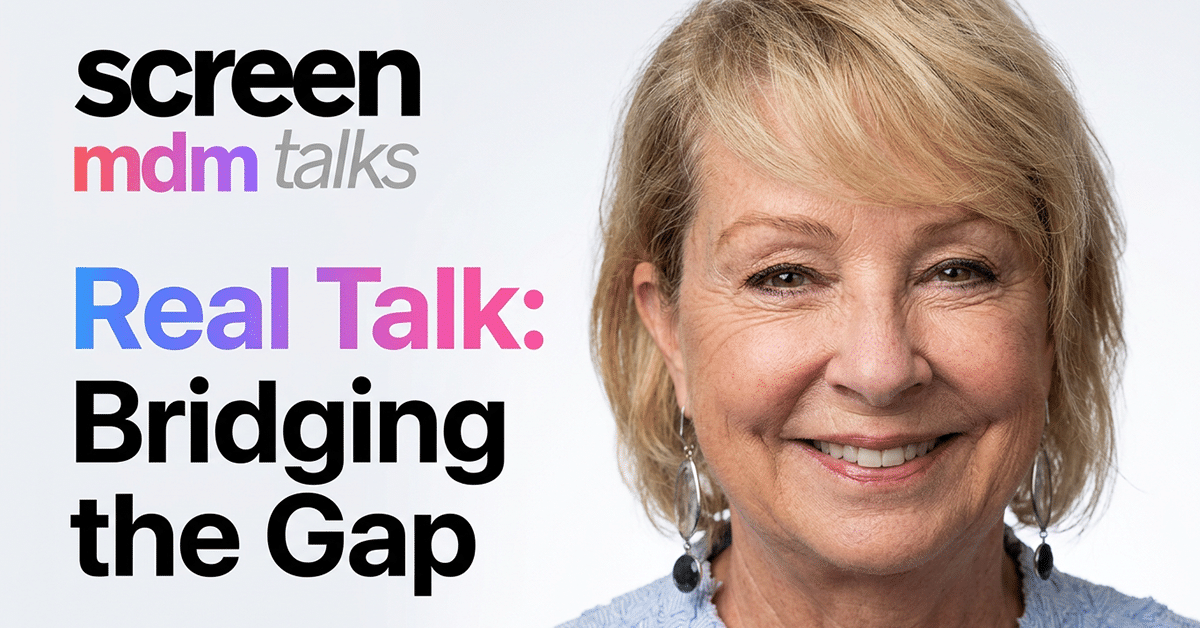
Amanda Groom, founder and CEO of The Bridge, joins ScreenMDM Talks to offer her takeaways on the key trends that emerged out of Sunny Side of the Doc, including the continued importance of co-productions and PSBs in commissioning high-end docs, the keys to navigating the quest for alternative funding sources, and the role of AI in factual shows.
Groom’s The Bridge has developed significant expertise in negotiating strategic alliances in “places that others don’t go,” she says on the latest edition of ScreenMDM Talks, referencing markets like India and Brazil, “and we are increasingly busy. One of the main takeaways from Sunny Side is that the market increasingly is about co-production. No one has the funds anymore to do single productions, certainly not if you’re looking at any scale or pushing creative boundaries. That takes partners, an increasing number of partners in many cases. So everything is about collaboration.”


With the conference market being completely reshaped amid the end of Realscreen Summit and MIPTV, and Sunny Side in La Rochelle being replaced by a new event in Strasbourg in 2027, there “was a whole feeling about the fragility of the physical on-site marketplaces that factual producers need and of the whole documentary and factual industry,” Groom says of the atmosphere at the event. “There was an urgency because the challenges have really set in and they’re not being alleviated. There was a real drive to do business, to make it work, to push it through.”
Watch the entire episode on YouTube or Spotify or keep reading for more insights from Groom.
In La Rochelle, Groom moderated a panel on funding models of the future, an increasingly pressing question as social media takes a greater share of viewing time and advertiser budgets. “YouTube, TikTok and Instagram are not paying for content to be made,” Groom said. “The broadcasters on the whole are still putting in a significant percentage. The rough estimate was about 60% of production budgets. Broadcasters are not dead; they’re a key part of the whole development process, albeit they don’t have the funding they once did.”
As a result, the co-pro mandate is even more important for broadcasters as they look to make “loud, noisy, brilliant, extraordinary documentaries,” Groom says.
Groom also tackled the subject of alternative funding models, including partnering with tourism boards and other government entities, a space she is well familiar with. The key to making those relationships work, Groom says, lies in transparency “about what can be done and what can’t be done. And the consequences of breaking down the trust that the production might have with the audience, not to mention Ofcom and the actual regulations. And when it comes now to the more sophisticated brands, where the message is going to be much more integrated within the storyline, a lot of them have their own entire departments dedicated to making this work in such a way that it doesn’t bash the audience over the head but in fact becomes an integral part of the piece.”
The quest for other funding sources is critical, Groom says. “Doc and factual is really struggling. The streamers aren’t looking for controversial documentaries. For things that are political and/or uncomfortable truths that don’t cause us to just sit back and feel good about ourselves but actually cause us to question ourselves and the world we’re living in, the onus for that is still very much falling into the lap of the public service broadcasters, and of course they have reduced license fees.”
Groom also touched on the role of AI in the factual segment today, particularly when it comes to unearthing archive footage. “AI offers huge potential. We’re also tiptoeing around some of the implications, complications, the consequences of doing this. We’re doing a lot at the moment in India; AI is uncovering Indian stories we’ve never known before with the most extraordinary archives.”
Groom did not leave Sunny Side with a sense of doom and gloom about the business but rather with a feeling that the challenges of the sector can be worked through with clarity and collaboration. “We’re all in the same boat, and there is no one coming to rescue us. We have to get ourselves out of this. There was a lot of genuine knowledge sharing between everyone.”


