

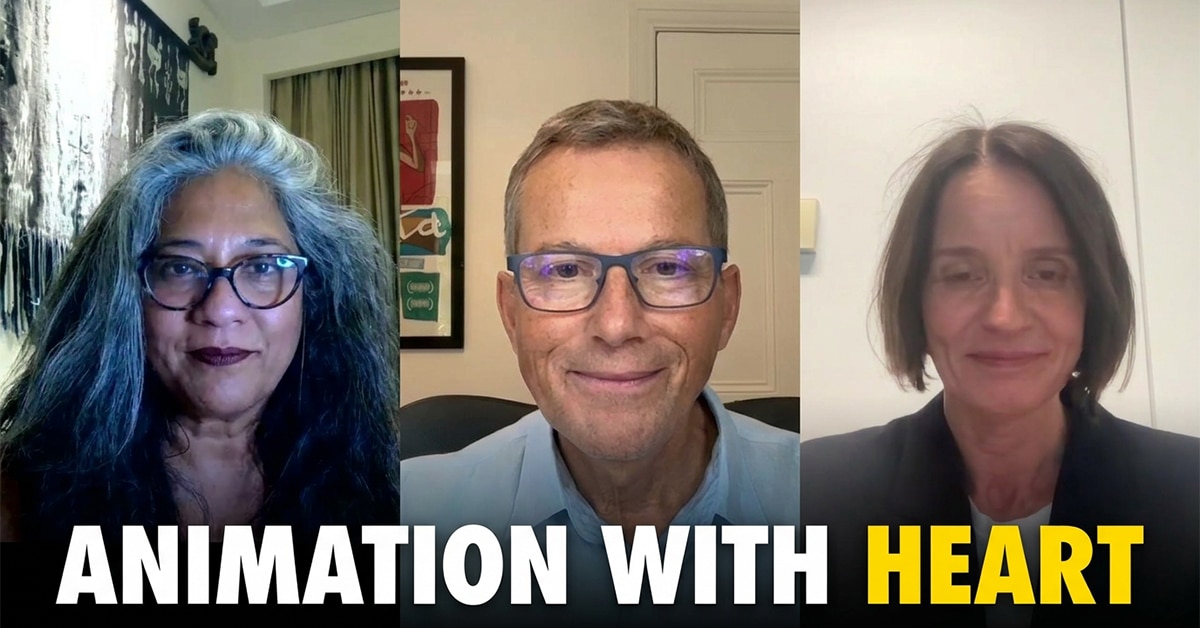
Two of the U.K.’s most respected names in children’s content have joined forces to bring a beloved IP to series; BBC Studios Kids & Family’s Cecilia Persson and Magic Light Pictures’ Michael Rose join ScreenMDM Talks to discuss their partnership to bring the beloved publishing IP Zog, previously adapted into two animated specials, into a full 52-episode series.
For Rose, joint CEO at Magic Light Pictures with Martin Pope, the origin of the Zog animated series dates back to well before this partnership with BBC Studios Kids & Family was announced early last year. Since its founding in 2003, Magic Light has delivered a range of beautiful animated specials based on the best-selling books by Julia Donaldson and Axel Scheffler, beginning with The Gruffalo in 2009. Zog arrived in 2018, with the sequel Zog and the Flying Doctors two years later. That second special came out at the height of the pandemic in 2020, seeing a “misfit trio”—Zog the dragon, Princess Pearl, and Sir Gadabout—fly off into the sunset as a squabbling, dysfunctional flying doctor team.


“As we were finishing it, we were thinking, actually, here is a wonderful starting point for a series,” Rose says. “Caring was all around us at the time. We thought, here is a show about caring with three characters, all very different, with flaws and foibles, but they care. And here’s a chance that we can show children a world of caring: how to care for yourself, how to care for those around you.”
Donaldson had long resisted a series adaptation but was moved by the potential for Zog, and for Magic Light Pictures, the BBC, a longtime partner, was the first port of call. “All our works have premiered on BBC One on Christmas Day in prime-time family slots. So it was the first and most natural place to take the show, and they embraced the idea very much. ZDF in Germany has also supported all our work since 2009, and they also came on board very quickly.”
Those specials were all distributed by Magic Light Pictures’ in-house distribution team as part of the company’s strategy for maintaining full control of its stable of IP. But when it came to Zog, “we were very much aware that the world has changed, the world of distribution has changed, and in launching a big new show and wanting it to reach all over the world, we wanted more heft,” Rose explains.
That strategic remit led Magic Light to BBC Studios Kids & Family, based on their “amazing track record, expertise and global reach,” to clinch a distribution pact for the 52-episode series.
“I’ve been a huge fan of Magic Light Pictures, everything that they do,” Persson, managing director of BBC Studios Kids & Family, says in the podcast, which you can watch on YouTube or Spotify, or keep reading the interview below.
“Any chance to work with award-winning people is always very exciting. So we saw this as a really marvelous opportunity. BBC Studios has end-to-end capabilities, so we can partner in so many different ways. And this was a fantastic opportunity for us to take on the distribution outside of ZDF and the BBC and also work on the licensing in Australia, Asia, and the U.S. So it felt very natural.”
The specials sold into some 180 markets, so the brand recognition has been clear as the two companies have been pitching the show to potential partners, beginning at Kidscreen Summit and BBC Showcase earlier this year, and set to continue as the kids’ industry convenes at Annecy this week.
The process, as with any animated series, has not been without its challenges. Magic Light made a series before (two seasons of Pip and Posy), but there were logistical and creative challenges, all against the backdrop of its Scottish production services partner, Wild Child Animation, going into administration. (Magic Light has since bought out the operation and rebranded it as Stirling Animation Studio.)
“All production is complex,” Rose says. “Each day brings challenges, and you deal with them. We had serious experience and understood the demands of a pipeline and structuring a long-running show. When it came to Zog, though, there was the additional challenge that our audience knows a certain look of the specials, which is high-end CGI animation. In taking Zog to series, we wanted to give that audience a similar experience on a series. How do you achieve that on a series budget?”
That answer lay in Unreal Engine, which “allowed us to take the assets from the specials, input them and output a look which is very, very close to the specials, but on a series budget.”
Creatively, meanwhile, the writing team led by Matt Baker, set out to expand the universe from the books and two specials into a world that could easily house 52 episodes—and hopefully more. That involved “thinking about who the characters were, what they wanted, how they functioned, and building out a world where we could bring in some additional characters and wider environments, but with this wonderfully dysfunctional trio of Zog, Pearl, and Gadabout, always at its heart.”
It’s been six years since the last special was released, and the kids’ content universe is unrecognizable in the changes since then. In introducing/reintroducing the brand as a full series, Persson and her team have been highlighting the storytelling and visual continuity. “The scripts have that quality, fun, and that humor, and a bit of the irreverence that the specials had as well. So it feels very joyous and comfortable when you’re watching it because you feel like you’re back to where the specials are. There is something about when you have characters that have had room to breathe, and that are very easy to get along with right away when you see them in an 11-minute format. There is a sophistication here that works on that level for parents as well, which means that it’s really great for co-viewing. And that’s something that we can talk to potential partners about and have proof points to show.”
The themes that underpin Zog—kindness and caring—carry into the approach to the audience and commercial partnerships, Rose and Persson said.
“At the heart of what we do is wanting to delight that young audience, fire up their imaginations, and inspire them to live creatively and think imaginatively. Hopefully, they might even think about a life of caring in some way, shape, or form, whatever that means to them. We always start with the audience—they are our focus throughout the whole process, thinking about what we do, how we do it, how we reach them,” Rose explained. “That’s why we wanted to work with BBC Studios because they have such a great track record of bringing stuff to the right places.”
Persson added, “Zog, these characters, and how they inspire all ages, are very important in the partnerships that you have. ‘Be more Zog,’ is something that our team talks to partners about. Helping, caring, coming together.”
As challenging as the premium animation market for kids’ may feel, Magic Light’s Rose remains uplifted by the “power of storytelling” and how great narratives can impact audiences everywhere. “No matter how much the world around us changes, no matter how much platforms change and adapt, technology does whatever it does, we have a core belief that if you do something of quality, it will find an audience and it will find the right platforms, and for many years to come.”
“It’s the timelessness as well,” Persson adds. “There is something about animation that inspires. Every generation has its shows they’re connected with; that tells the stories that are needed and desired then. which obviously goes along with quality. I also really find a lot of strength and excitement around the partnerships, working with Michael and Martin and Magic Light Pictures, the sum of our parts makes us be stronger and better.”