
ScreenMDM Extra takes a deep dive into the battle for dominance in the CTV era, exploring trends at leading TV OS platforms and AVOD services.
In this post for our Substack subscribers and ScreenMDM Club members, excerpted from the ScreenMDM Digital-Shift White Paper, you’ll get insights on how an array of key CTV players are positioning their businesses, including Samsung TV Plus, Rakuten TV, TCL, wedotv, Tubi, and Roku.
More than 70% of European audiences are watching FAST channels daily or several times a week, according to research unveiled by Rakuten TV at SXSW London. Just over 80% consider FAST a primary way to watch television or an alternative to paid streaming services. Further, 60.7% expect to increase their use of FAST services in the future.
Viewers are also largely fine with watching ads on FAST (82.3%), especially if they are relevant, help discover new content, or are simply accepted as part of accessing said content for free.
FAST is being powered by both financial and discovery imperatives; 45.9% of viewers surveyed for the Rakuten TV study use it to decide which subscription services are worth paying for, and 29.9% use it to help reduce overall spending.
Scaling the niches.
The key to success in FAST involves balancing broad reach and niche fandom. Per the study, movies and TV series remain the strongest drivers of engagement across Europe, while themed and genre-based channels are a key growth opportunity. Indeed, that is the only sector where audience demand exceeds current viewing behavior, suggesting that specialized content experiences are not yet available at scale. And local content is paramount.
There are differences emerging across key European territories.
In the U.K., FAST is increasingly driving content discovery and subscription decision-making. In Germany, subscription fatigue is contributing to FAST adoption. Local is particularly important in Spain and Italy.
Where the money is.
The CTV advertising sector will be worth $81 billion by 2030, Omdia projects, surging from last year’s $44 billion, with Google, Amazon, and Netflix expected to capture half of that market.
CTV advertising will surpass traditional linear TV advertising during the 2030s, Omdia says, with the center of power shifting clearly away from traditional broadcasting to streaming, TV OS players, and advertising ecosystems. By 2030, Google will capture a 26% share of global CTV ad revenues, driven by YouTube’s dominance in the living room, with Amazon at 13% and Netflix at 9%.
The factors driving the CTV ad market include the expansion of ad-supported tiers on streamers, the convergence of retail media and TV advertising, gains in programmatic and targeted TV advertising, the expanding role of TV OS platforms and smart TV ecosystems, and the rapidly intensifying battle for consumer attention.
“The battle for the living room is no longer only about streaming content,” said Maria Rua Aguete, head of media and entertainment at Omdia, in the study. “It is increasingly about controlling the platform, the advertising layer, the operating system, the data, and ultimately the consumer relationship.”
Tech companies are increasingly competing to control the TV interface itself, Omdia notes, as CTV becomes a key gateway for digital advertising, retail media, and commerce integration.
Mobile viewing is affecting CTV viewing.
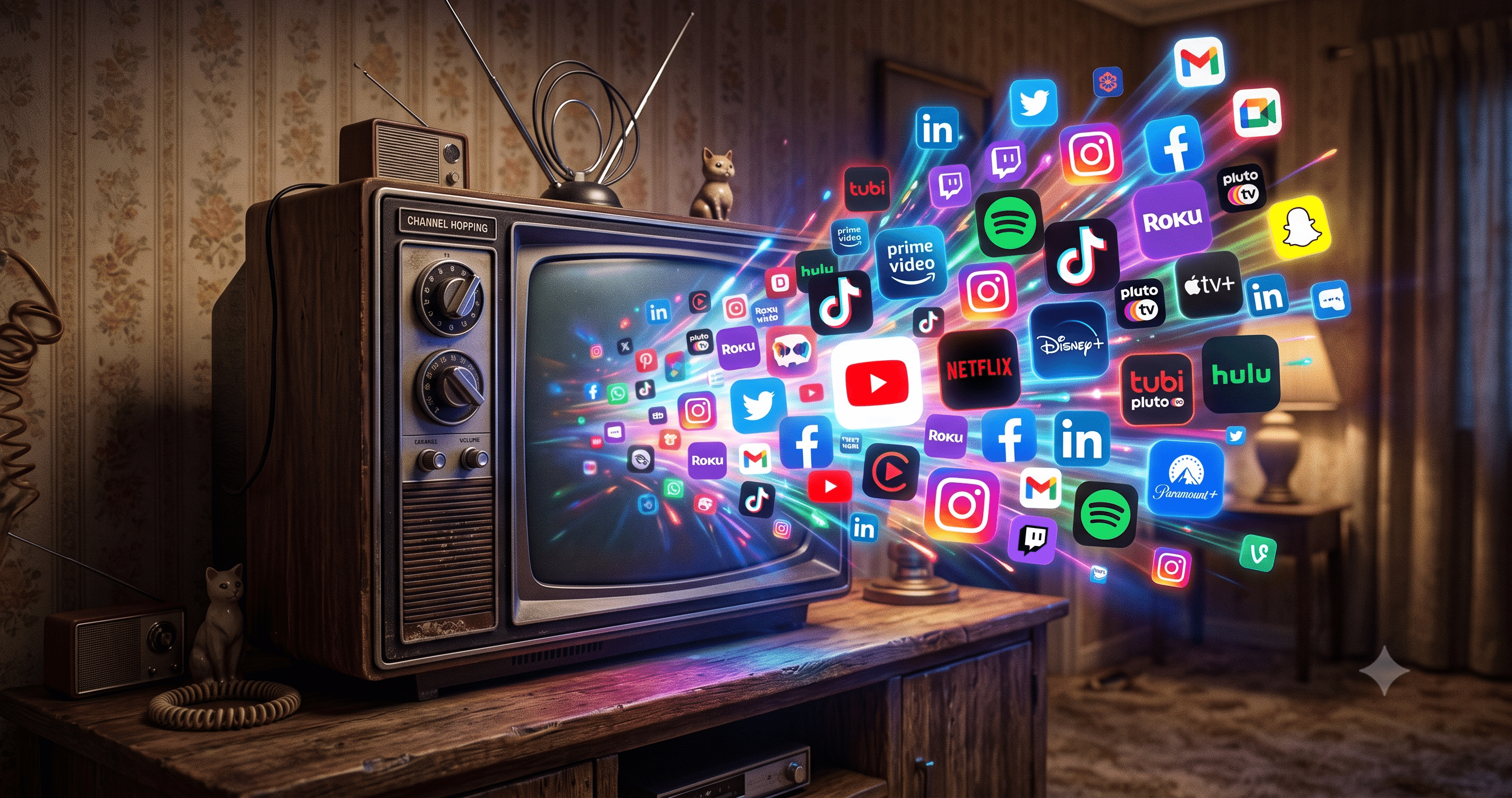
Samsung Ads’ Behind the Screens report says that in this new fragmented era, viewing habits have become “fluid,” hewing closer to smartphone usage trends than the old days of channel hopping.
Key stats include that the average household uses five apps. The number of apps embedded in smart TV ecosystems continues to balloon, rising by 8% last year to reach 18.4 billion launches. “Fragmentation is no longer just about more services—it reflects audiences actively spreading their attention across a wider range of platforms,” the report indicates.
Use SCREENMDMEXTRA for an exclusive 20% discount on the ScreenMDM Digital-Shift White Paper.
Platform loyalty doesn’t matter a ton—it’s content that viewers are chasing across the landscape.
No single ecosystem is winning in CTV, the report notes: 24% of Samsung TVs account for 81% of all linear viewing, while 27% of Samsung TVs stream and never watch linear.
It’s not FAST, it’s free television. Audiences don’t care about the delivery method.
“It doesn’t matter if it’s VOD, linear, or broadcast,” said Shujah Farooq, partnerships and content acquisition manager at TCL, at StreamTV Europe. “You just want free content.”
“We try to abandon the name FAST, because we think that’s not the right definition,” Philipp Rotermund of wedotv told me recently. “If you take the streaming out of the name, it’s free TV.”
The CTV FAST operators are an essential piece of the puzzle for wedotv, but that’s not the only space the AVOD platform and FAST channel operator is looking to for expansion. “In the end, we are in the business of selling eyeballs,” Rotermund said. “So, we have to get in front of the eyeballs. And that’s why in any market, we want to have full coverage.”
For more, including insights on Samsung TV Plus, Rakuten TV, TCL, Tubi, and Roku, upgrade to a paid Substack subscription or become a ScreenMDM Club member.