

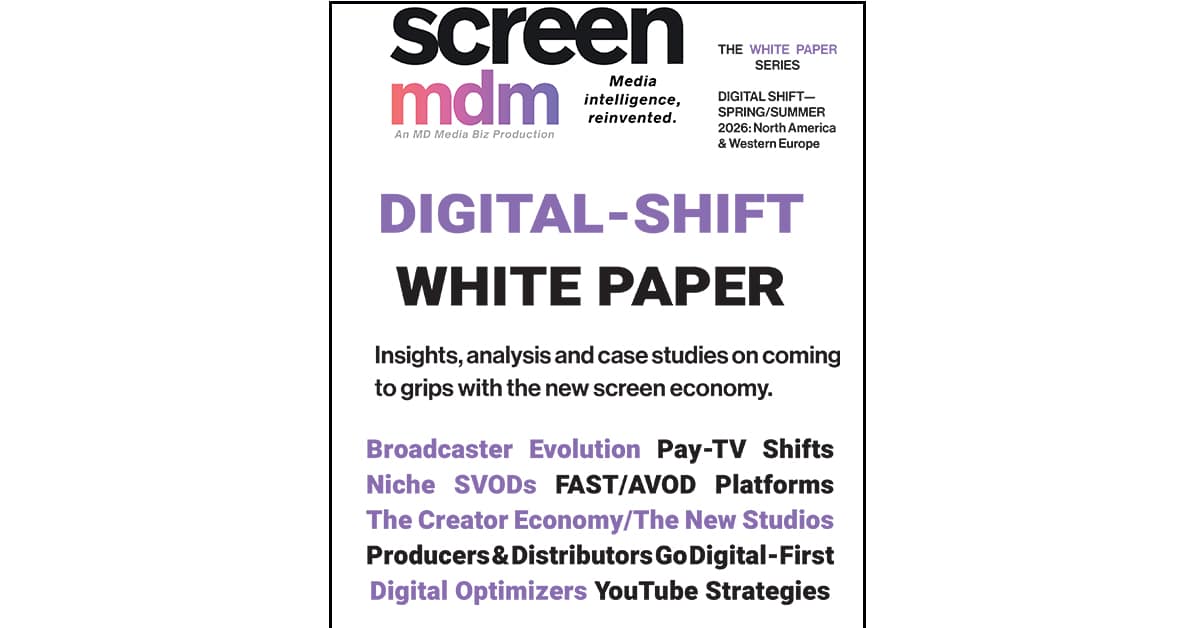
ScreenMDM’s inaugural White Paper, Digital-Shift, delivers practical insights for making sense of the trends reshaping content production, monetization, and distribution.
The pace of change in the media business today is unrelenting. From consumption habits to monetization models to the technology underpinning everything. Change is the only constant, and figuring out how to understand that principle and adapt to it was the thinking behind the launch of ScreenMDM’s White Paper Series.
We are not here to give you audience numbers or revenue projections, but rather to share case studies on how execs are making the most of disruption and transformation to chart new paths for their businesses.
Digital-Shift: Spring/Summer 2026 focuses largely on North America and Western Europe, exploring how various sectors of the ecosystem are adapting, from free-TV broadcasters to pay-TV channels, niche SVOD services to IP owners and distributors. At the heart of it is the ecosystem reshaping everything: the creator economy and social video.
Across 90 pages, the report features expert insights from 60-plus sources, organized into thematic sections. Bookmarked so you can easily find what you need, and it’s printable. We hope it’s a resource you return to as you make sense of the ever-evolving business of creating, producing, and distributing content.
What’s Inside:
Free-TV Legacy: Perspectives from ITV & Freely
CEE’s Local Champion: CME
Iberia in Focus: Input from RTVE, RTP, & Impresa
The News Angle: TF1’s Digital Creator Pact
The Economics of Streaming: The Bedrock Perspective
It’s Not Aggregation, It’s Curation: The View from Virgin Media
Cable Evolution: The Channel Perspective
Winning the Living Room Battle:: Insights from RTL AdAlliance
News Right Now
Digital Commissioning: The View from MTV
The Other SVODs: Niche Streamer Wins
IP Owners: Embracing YouTube, Monetizing on FAST & Driving Discovery
CTV Battles: The AVOD & FAST Platforms
YouTube on YouTube
The Optimizers Making Sense of Social
The New Studios
Ready to purchase for just US$129? Go here.
We have discount codes for the experts quoted and for indie one- to two-person operations. Email me if you fall into either of those categories! ScreenMDM Club members—your free copy is being emailed to you. If you missed it, let me know! ScreenMDM Extra subscribers also have their own discount code; check your Substack app.
You’ll see some recurring themes across this report: fragmentation, fandom, being multiplatform in distribution and creation, and constant optimization.
In the White Paper, I aim to distill what those things mean in practice, drawing on insights from the executives who are figuring them out every day. From panels and keynotes at global content summits to dozens of interviews and countless news stories, this White Paper features practical intelligence for making sense of this new screen economy.
We’ve all seen the numbers, over and over again. Audiences of every age are spending more and more of their time on social video platforms. The YouTube Era: 2025 in Review report from Digital i Research laid this out clearly. Across 20 major markets, average daily usage of YouTube per account rose from 87.2 minutes to 99.1 minutes from 2024 to 2025. In contrast, Netflix’s daily engagement slipped from 100.5 minutes to 93.4.
“YouTube’s evolution from a social video service into a dominant global attention platform is one of the defining media shifts of the decade,” said Matt Ross, Digital i’s chief analytics officer, in the study. “Our data shows audiences increasingly treating YouTube not as social media, but as a primary entertainment destination.”
Social media has become the “top of funnel for every brand, studio, and creator in the entire world,” Chronicle Studios’ Aaron Sisto said on ScreenMDM Talks. “Unless you are getting discovered, unless you’re getting your content to the right audiences on these platforms like YouTube, you’re in many ways irrelevant. That’s the number one challenge that we’ve seen for anyone from an indie creator to a massive studio. How do you get your content discovered? How do you really engage that core fan base? And then ultimately, how do you bring them along for the journey?”
Gen Z is still the most engaged audience on YouTube at 111 minutes a day, Digital i said, but the biggest gains were seen among men 55 to 64, with usage up 15% year on year. Usage by women across demos also rose, with the biggest gain among women aged 18 to 24. Overall, daily usage among the 55 to 64-year-olds rose to 81.4 minutes.
Crucially, younger audiences are not going to magically return to traditional platforms when they reach their 30s and 40s.
“If you think your media enterprise can speak to millennials and younger, who grew up with supercomputers in their pockets, who have had social media in their hands since grade school, you’re out of your minds,” media cartographer Evan Shapiro said at StreamTV in Lisbon. “You have to change the way you do business, because the way people consume has dramatically shifted, not because of technology. Technology is definitely the tool that makes new consumption possible, but the generational shift of the population of the planet Earth is what always drives innovation. That’s what drives change. And you need to see the world through the eyes of younger consumers in order to see the whole consumer.”
“Young people have a different content paradigm,” explained Jon Giegengack, founder and principal at Hub Entertainment Research, also at StreamTV Europe. “People 35 and over, the number one and number two things they watch regularly are movies and TV shows. People under 25 watch short videos, and YouTube is number one and number two. But 61% of them still watch movies regularly. 54% still watch TV shows regularly. But the reality is that long form is not where they begin.”
“The YouTubers of the first generation are in their 40s,” said Tobias Schiwek of We Are Era at MIP London. “Their children do not watch linear TV. It’s the last window that is closing. If people do not replace centralized power with distributed power, they will lose the next round.”
Ultimately, “television has been replaced by the combination of streaming and social video,” Shapiro said. “You have to think of the whole consumer, not the TV consumer and the mobile consumer, not horizontal or vertical, but the whole consumer, wherever they go.”
And that is as much a creative shift as it is a distribution one, A+E Global Media’s Robert Sharenow said at Realscreen Summit. “It always ends up being a creative foot race. Whatever the disruption is, some people are going to win, some people are going to lose.”
Helpful tips on how to win are featured in the White Paper. All of these companies are in different stages in their own evolutions. Free-TV broadcasters embracing social video strategies, traditional studios launching digital-first slates, channel brands reinventing their businesses, tech providers powering expansion, AVOD platforms and streamers leaning into the creator economy, the new studios that have emerged from social media, and the optimizers at the center, helping players from both sides intersect.
To buy it, go here.