



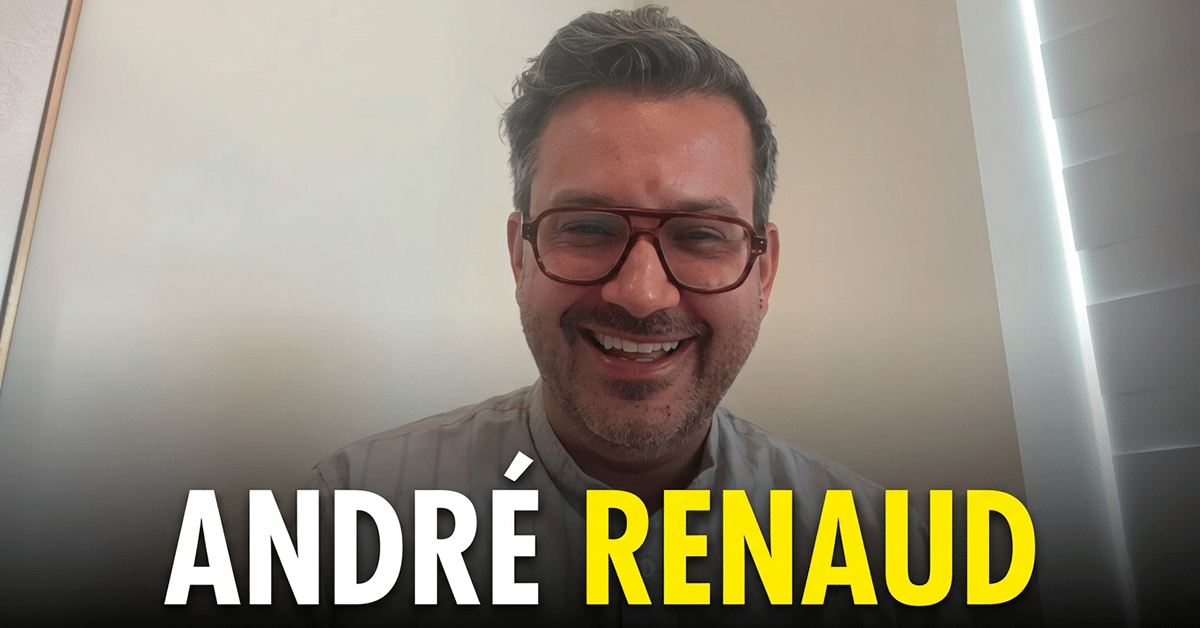
André Renaud, general VP of format and finished sales at Warner Bros. International Television Production (WBITVP), joins ScreenMDM Talks’ Format Zone strand to talk entertainment and reality trends, battling risk aversion, and 360-degree brand building.
Renaud said he came out of Content Europe feeling “revitalized” about the format sector, having headed into the event unsure “about the direction of the industry.” And on entertainment formats specifically, “it’s probably the most fascinating time.”

The megaformats are still “the name of the game for commissioners,” Renaud explains. “People are reluctant to pull them off and try something new because the hit rate benchmarks are so much higher now for entertainment. You have to really have a good, cost-effective production, and you have to get really high ratings—when we’re working on a declining linear base.”
Watch the full interview with Renaud below or on Spotify here. Prefer reading? More below.
Battling Risk Aversion
While there are some territories where new ideas are breaking through (he referenced the Netherlands), “it is a fact that entertainment format sales have been declining year on year in favor of things like reality.”
Fortunately, reality is a broad tent, from The Traitors to Real Housewives; “so it depends on how you define entertainment now.”
Whatever the subgenre, “the big juggernauts remain, but people have less money to put into places. So they’re going to try to put it into the things that are either cheaper or returnable. So reality and game shows are probably where I think people are pivoting to, but trying to find entertaining ways to do it.”
Creativity thrives in limitations, Renaud said. “It’s helped us rethink a few things. One is: how do you make something entertaining more cheaply?” Referencing WBITV’s own Class Clowns for ABC in Australia, he said, “You can create entertainment, but make it comedic, bring in talent, and try to find a way to do something that doesn’t feel like it requires a huge studio setting.”
Renaud went on to discuss genre hybridization with properties like Can’t Stop Media’s The A-Talks and WBITVP’s own Inside Therapy, which is headed to Spain on RTVE.
“People are being more thoughtful now in a risk-averse world about what they’re investing in, but I think the green shoots on that is how we explore what the genre definition is.”
The New 360
Entire ecosystems are being built around successful brands, including a handful of new 24/7 versions that run across both broadcast and streaming. It’s not a new concept, Renaud said. “Aren’t we just going back to the early 2000s when digital took off, and Big Brother had a live feed on E4 but was airing on Channel 4?”
Today, however, “we’re moving from our TVs to our laptops to our phones or tablets. We want something that follows us around as we go. So maybe that is also something that keeps the momentum building.”
To that point, “the shape of the conversations that we have is a lot more 360 than it used to be.”
Renaud referenced Glow Up, the BBC Three beauty competition format, as a case study in how social reach can be baked directly into a format’s commercial proposition. “Beauty is one of the highest value revenue-return categories on TikTok and YouTube,” he said. And social is the bridge that can help bring younger audiences to linear brands.
By the Script
Renaud is also looking for opportunities in scripted formats, given the studio’s deep library. “The appetite is still there,” he said, “but cost versus viewership versus competition is the metric. I still maintain that a scripted format is the fastest, cheapest way to develop a drama and get it on screen; you can have a brand new drama in months, not years.”
But, Renaud said, scripted slots are competitive, and “there’s still a lot of acquired content that you can get from the U.S. or the U.K. or elsewhere that fills those slots cheaply. A local drama will always outrate an acquired one,” but it comes with the high “cost of energy of putting that together.”
As such, Renaud is looking at markets where “demand from viewership outweighs the pace at which people can deliver,” namely Turkey and India.
In addition to his role at WBITV, Renaud serves as co-chair of FRAPA alongside All3Media International’s Nick Smith. Over the last few months, they’ve been engaging with the format community at key events like MIP London and Content Europe. Discussions have largely centered on AI, staying relevant, and finding new paths to landing a commission.
Copyright protection continues to be FRAPA’s key focal point. “Where is the line between parity and ripping off?” Renaud said, referencing viral hits like Fruit Love Island. “The thing that’s interesting about Fruit Love Island is that it shows that formats still have a strong, relevant place in the world. If you want to parody it, it must be important! But there’s still an urgent need for discussion on how to support and protect the huge amount of time and money that goes into developing a show that becomes a hit.”
Across his day job and his work at FRAPA, Renaud is seeing a new spirit of collaboration in the industry. “I think we have to be a lot more thoughtful, generally, about who our competitors are. People are saying, I only have a third of my budget. OK, but what if I manage to get that second window? People are becoming a lot more flexible. I think we have to.”


