

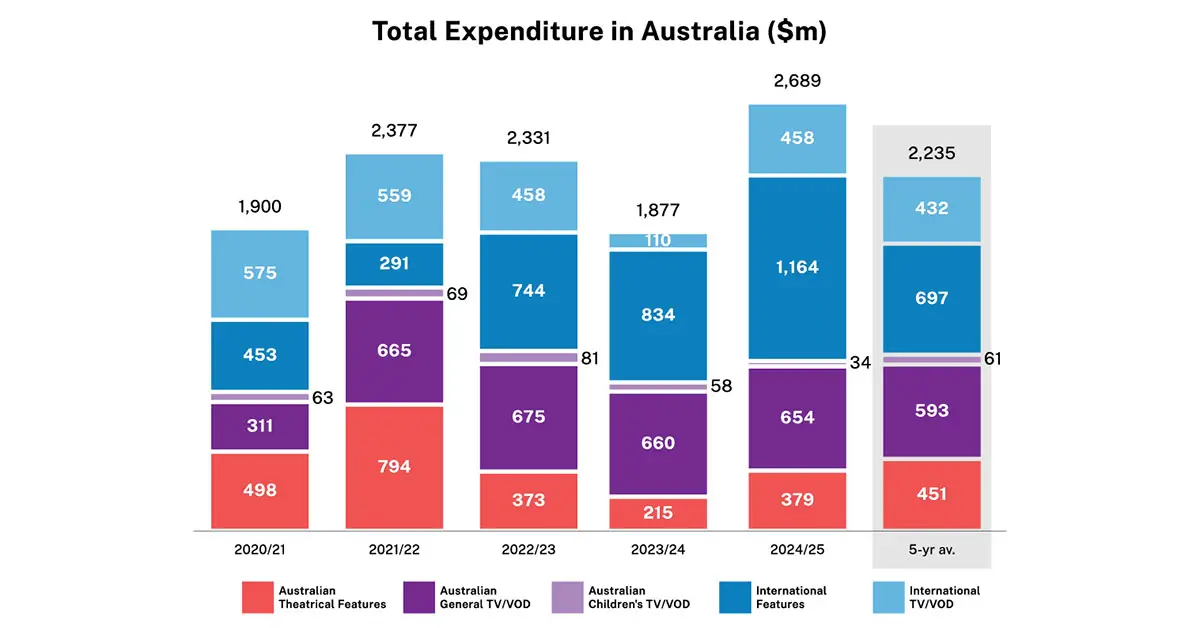
Drama production expenditure in Australia reached a record A$2.7 billion in 2024/2025, a 43% year-on-year gain, according to a new report from Screen Australia.
A total of 174 titles entered production in the period. Of those, 71 were Australian, with expenditure on local stories hitting A$1.1 billion, an increase of 14%. Spending by international TV and VOD productions amounted to A$458 million. Spend on 32 Australian general TV/VOD drama titles slipped by 1% to $654 million, with subscription TV and streaming at A$492 million on 18 titles, a 5% gain, and free TV at A$162 million on 14 titles, a 14% drop.

“This strong result is a testament to the hard work and creativity of our screen practitioners, who are navigating a rapidly evolving landscape,” said Deirdre Brennan, CEO of Screen Australia. “The numbers reflect a complex story of production value and content volume. While there is moderate growth in local drama expenditure, fewer TV titles entered production across free-to-air, subscription-video-on-demand and children’s content, showing ongoing shifts in commissioning behaviour. This presents an industry challenge, but also an opportunity to seek out new areas of collaboration and innovative production to ensure we continue to elevate Australian storytelling.”
Brennan continued, “In the current market, research and insights are vital for screen creatives and businesses looking to make future-focused decisions. The Drama Report is an indicator of narrative trends. When assessing the state of the industry, we consider this report alongside the pipeline of projects seeking development and production funding, feedback from global markets and data tracking across all genres, including documentary.”
Kate Marks, CEO of Ausfilm, added, “We celebrate this record level of international production activity, driven by the reformed Location Offset. This activity helps sustain the ecosystem that supports Australian stories by keeping our crews working, funding training, enabling investments into screen businesses and building capabilities. At a time of global industry disruption, the ongoing mix of local and international work makes our screen industry resilient, sustainable and globally competitive.”