

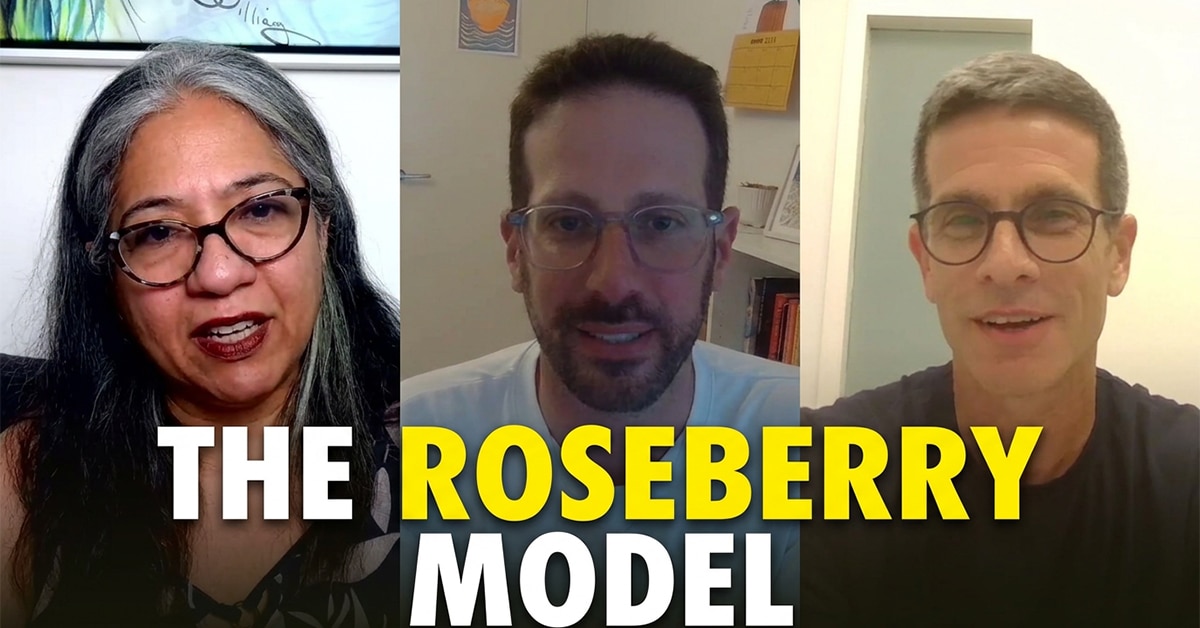
On the heels of the launch of their new vertical video platform Epis, Guy Hameiri and Lior Friedman, co-founders of RoseBerry Media, joined ScreenMDM Talks to discuss reformatting content for mobile-first audiences and leveraging data and analytics to chart a new path in premium, short-form, 9:16 content.
Like many in the “traditional” content ecosystem, Hameiri and Friedman have embraced the vertical video revolution, leveraging their deep experience in content production and monetization—Hameiri co-founded Abot Hameiri (now Fremantle Israel), and Friedman is the former SVP at Amagi—at RoseBerry Media. The venture officially launched its content studio in May, aligning with several top-tier distributors to reformat IPs for the vertical video space, utilizing their proprietary AI solution, Red Snapper. Their new platform, Epis, arrived this month with a mix of reformatted shows as well as originals.
“We have a super different take on what people call microdrama at the moment,” Hameiri says in the latest episode of The SwitchScreen strand on how RoseBerry is approaching the vertical video space. Expanding well beyond the traditional microdrama tropes, RoseBerry sees 9:16 potential in a range of content formats.
“It’s a time of massive change when it comes to consumer behavior,” Friedman says in the episode, which you can watch on YouTube or Spotify. “There are user bases throughout the world, not just in mobile native countries but in much more developed countries, that consume all their entertainment on their mobile devices, and they deserve a better content offering than they’re getting today—that’s the gap that we saw in the market that we think we can fill.”
This article continues below the video player.
Building An Ecosystem
Epis is key to validating those beliefs and rounding out the RoseBerry ecosystem, Hameiri says. “We see ourselves as a studio that knows how to produce and take care of all different genres that you can find in content. If microdrama is one specific genre, we’re working with others: true crime, reality, dating reality, and premium drama. Once we knew how to produce originals in these genres and A/B-tested them, we saw that the audience is willing to pay for them. That’s how we started our repurposing side of the studio, which is taking libraries from amazing partners and turning them from horizontal into vertical content. Epis is a distribution method, but it’s also a tool for data and user behavior that helps us grow our content. It’s helping us shape the behavior of the users and then also making sure that the content can be distributed in its best shape.”
The venture has assembled an impressive base of content partners, including A+E Global Media, Banijay Rights, and Fremantle. For distributors, “it’s more than just a new window,” Friedman explains. “The shift in consumption requires not just another exhibition window or exploitation window, but actually new tools to deal with it. Mobile is not television. Mobile has completely different engagement tools with its core audience. This is unlike TV, where you sit down, lay the remote next to you, decide on a piece of content, and you let the programmer or the algorithm take control of your time. Mobile is much more of a competitive landscape; your thumb is always able to flip the channel or swipe or change to a different app. It’s much more demanding in that sense. And that requires a completely different tool set when it comes to how content can behave in that type of fight for attention.”
Changing Frames
When it comes to reformatting shows for vertical, “You need to create different story arcs to tell the same story that worked for TV,” Friedman continues. “You need to refine that story, break it down into the core fundamentals, and tell a story that has a beginning, a middle, an end, and a hook that constantly keeps you engaged.”
The pitch to leading distributors, Friedman says, has been: “This is a new language that you need to speak. We are, if you will, the Google translator for that specific language, and we will provide you with those tools. We have a system that does that, but we also have a creative team that oversees that system and constantly adapts based on the signals that we’re getting.”
Mining the Data
The treasure trove of analytics from mobile consumption is significantly more granular than TV consumption, Friedman continues. “A mobile device knows your location, your network, where your thumb is at, where your eyeball is; there’s so much that you can gather from a mobile device about how to design a story, how to build the arc. Where exactly do you want to meet the user when it comes to their engagement, payment intent, consumption intent, or churn intent? All of those things are part and parcel of a process that is much more difficult to predict in a TV-like experience, but is much easier to control and predict in the mobile environment. We’re bringing together all these tools.”
And they’re just getting started, Friedman continues. “This is day zero or even day minus one of the vertical TV revolution. We want to be there together with our partners when that volcano erupts.”
The constant testing, iteration, and experimentation will ultimately benefit viewers, Hameiri adds. “The user behavior that you want to see on mobile has a lot of retention and engagement in it. You want to make sure that people want to continue watching one series after the other. And not just be hunted by social media in a financed campaign on a user-acquisition basis. How do we make sure that the user will visit the same app five times a month, on a monthly subscription basis? It’s a different behavior than: let’s chase the user and make sure they buy enough coins.”
Hameiri refers to the mobile entertainment space as “the new cable—you can bundle TV, film, documentary, true crime, you can do all these sorts of things if you find the right way that people want to consume full-length content on mobile. That’s the solution that we’re working on constantly.”
Mobile video can be quickly adjusted to respond to what audiences want and don’t want, Hameiri adds. “We can explore and examine our data every single day, every single moment. If we see that there is a problem in minute eight, 34 seconds, we can go back and correct that, put it in better shape, and put it back on the mobile, on the streamer. On TV, it’s much harder to do. This is where Epis comes in because when we do have the second window in terms of selling to other streamers, we give it to them in its best shape after we’ve seen the data and the user behavior.”
AI is paramount to the data analytics and content reformatting processes; less so in the creative storytelling, Hameiri says. “Red Snapper, let’s call it a repurposing machine, is built from a 12-step AI agent. We’re fully implementing AI in our technology in terms of production. We don’t do full AI stories. For now, we don’t think that AI stories can reach the same level as real human actors or real participants in a reality series. It could happen in three months, six months, but as for now, no.”
Untapped Opportunities
As Hameiri alludes to, the sector is developing rapidly, and the team at RoseBerry is keen to be a key part of the segment’s expansion. The opportunity is immense, Friedman says.
“Microdrama has a very specific behavior,” Hameiri says. “It’s freemium behavior with coins and a weekly subscription, and probably 90-some percent are females, ages 30 to 60. Where you see the revolution becoming bigger is widening the audience and growing the industry into a monthly subscription and a much higher retention and engagement viewership minutes per month. We believe that what we’re doing will drive the needle towards that direction.”
Operating at the intersection of tech and content is central to the RoseBerry model.
“We have a lot more tech companies today that are sitting on top of the attention charts; that’s just the way the world works right now,” Friedman says. “They’ve built the infrastructure that allows content to travel from one place to another in a better way than anyone else. But at the end of the day, it’s the storytellers that can bring in the next big thing that excites users in whatever format it is. Tech can’t do it without the content. Content can’t do it without the tech. We can’t deliver our own content without having the best tech, not only to deliver it, but also to learn from it and perfect it. We can’t tell the best stories without understanding what the audience wants, and we need tech for that. It’s about how you combine the two to provide the most consumer value there is. There’s never been a better time to tell stories using tech. And the barriers of entry in that sense have become so low that I think it’s super exciting to set foot in this world of professionally produced entertainment in the year 2026, with all the tools that we have at our disposal.”