

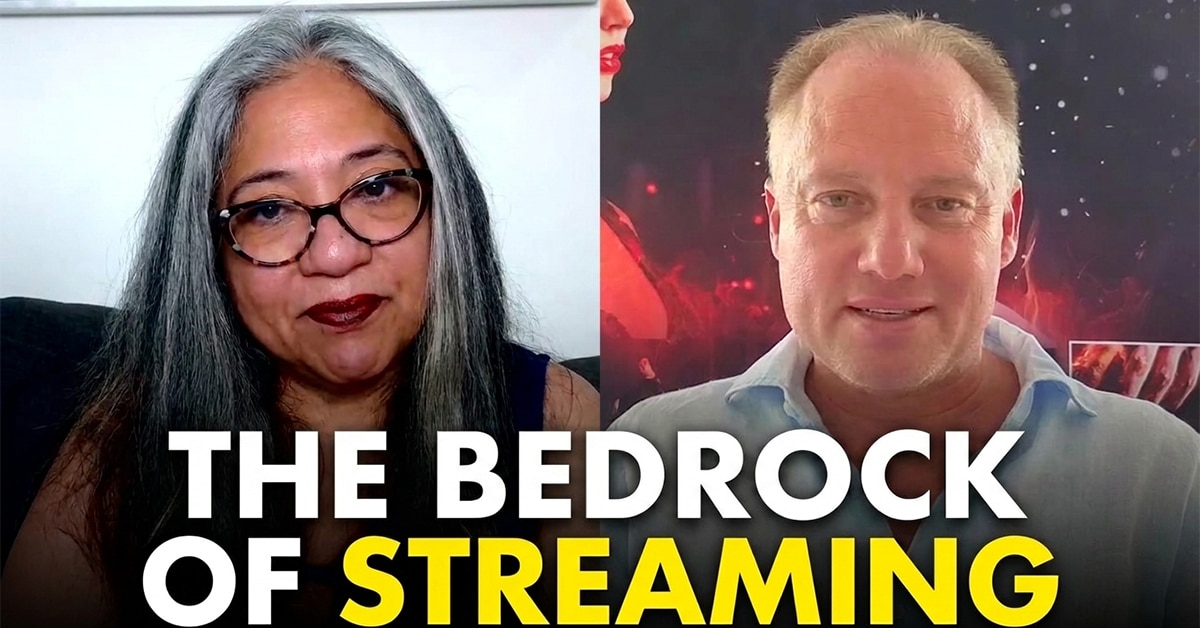
On the heels of the large-scale migration of RTL+ to the Bedrock tech stack, the streaming solutions provider’s CEO, Jonas Engwall, joins ScreenMDM Talks’ The SwitchScreen strand to discuss streaming profitability, European scale, and AI.
Bedrock is the Bertelsmann-owned streaming solutions provider that powers M6+ in France, Videoland in the Netherlands, and RTL+ in Germany. In this wide-ranging conversation with Engwall, we discussed streaming profitability benchmarks, the need for European collaboration to take on global tech giants, embracing AI, and tracking innovation across platforms worldwide.
The DPP, a provider of media and technology insights, working with Bedrock, introduced the Streaming Platform Ratio metric earlier this year to identify the share of a platform’s revenues spent on tech and operational costs. “It’s very difficult to benchmark and understand where your costs are, where they should be, and who you compare against,” Engwall says in the episode, available on YouTube, Spotify and Apple Podcasts.
He explains that official sources include Netflix’s SEC filings, which put it at a Streaming Platform Ratio of about 10%. That number is the industry’s gold standard—the median is about 16%, DPP found. “Some of our clients are already at 10%,” Engwall says. “That’s what we aim for. And obviously if we can be even better than 10%, that’s the goal.”
The road to reducing streaming costs as a percentage of revenues lies in achieving scale.
“We need scale to operate a streaming platform in a financially sound way,” Engwall says. “It’s a scale that you cannot reach in one European country. We’re just too small. It’s just as simple as that. Our platform, if you look under the hood, so to speak, is the same platform we operate in all countries. So that’s how we reach the scale.”
At the heart of Bedrock’s model is a platform built to enable significant configurability; scale matters, but platforms need to be customizable to local audience needs.
“Every end user experience in every country will look totally different. In one country, the platform might be AVOD; in another country, it’s SVOD. In one country it’s purely video, and in another country, we have podcasts, music, and audiobooks. We have feature flags where we can turn things on and off. We can configure everything. I use a Lego visualization. When we set up a new client, we define the Lego they’ll use. And then they can, by themselves, on an ongoing basis, do all the personalization and all the editorialization that they want. But it’s really the same platform across the countries, and that’s the secret sauce. You get a big platform, and you’re paying only a portion of that in each country.”
RTL+ is the latest platform to join the Bedrock tech stack. “To our knowledge, it’s by far the biggest streaming migration in Europe,” Engwall says of the move to transition 7 million paying subs and a further 4 to 5 million free users.
“You cannot afford to lose any of them in the mix,” Engwall says of the endeavor. “It’s a pretty delicate process. There’s no room for churn.”
Bedrock and RTL+ worked closely on the transition, which was done “device by device. We migrate, we look at all the KPIs, check that everything is green, and then we continue.”
While there’s no timeline in place, the plan is to eventually integrate WOW, the streaming platform operated by Sky Deutschland, now part of the RTL Group family, onto Bedrock. “This obviously plays into the scale card. It’s a win-win for everybody. So, the sooner the better, from my perspective.”
Our discussion about scale segued into the issue of European regulation, which Engwall believes needs modernization to enable the region’s media organizations to compete effectively against global behemoths.
“In some places, the regulatory authorities, in my opinion, are just behind the curve. I don’t think they realize how quickly the markets change. Historically, European markets, as you know, have been very local. Nowadays, you have all the global giants, and they’re the real competitors. It’s a pity that the European regulatory bodies are not fast enough to adapt and to see this market change. I think it’s coming. We need to collaborate more. We’re a little bit slow, I would argue, in Europe, in collaboration. We’ve been talking about it for so long, but it’s happening at a slow pace.”
As streaming platforms everywhere double down on live sports, Engwall shared how Bedrock prepared to handle an influx of audiences for M6+ during the World Cup. “A lot of people underestimate how much work it is to have the capabilities of onboarding those users smoothly,” Engwall says. “Building a streaming platform is already difficult; building for live peaks is even trickier. It’s a question of experience, cost, and preparation. We were prepared for above 7 million concurrent users; we were a little shy of 2 million, which is still a very substantial number and a pretty difficult number to handle.”
While load testing is an ongoing affair at Bedrock, it amped up those efforts at M6 in the run-up to the tournament and was on hand to fix any issues during the games. “We were there just in case. We were looking at all the dashboards, making sure that all the KPIs were good. It was a safety net. When it’s the World Cup, you want to be sure. If something goes wrong, at minimum you need to fix it very fast.”
Engwall also weighed in on streaming innovation in other parts of the world, including Asia, where he spent many years running the RTL CBS channels and then serving as head of the region at upstart streaming platform iflix. Convergence meets commerce is transforming Asia’s content ecosystem. On that front, Europe is at a very different stage, Engwall notes; convergence is being embraced, commerce, less so.
Convergence is increasingly important for many platforms in the battle for engagement, driving services to embrace short-form, podcasts, and more alongside live and on-demand content. Bedrock is helping to enable that expansion.
“Ultimately, you want to give an array of choices for the users and not have them leave. Our different partners, some of them want to have all of the above, so to speak, let’s say Germany, and others have podcasts but not audiobooks.”
Commerce, meanwhile, is more challenging in Europe, Engwall says. “When we did tests back in the day. It was difficult to get the return on investment because the tech costs around it weren’t covered by the consumption back then. This is one of those things we’ll probably try again eventually and see if consumers are more responsive. Asia is moving really fast. Even ten years ago, there was e-commerce on streaming.”
Vertical, meanwhile, where Asia has also led the charge, is a trend he expects will pick up in Europe.
“We are closely tracking what’s going on in Asia, and we try to adapt and bring things that are more acceptable in Europe. Other things will take time.”
Across its operations, AI is becoming an increasingly valuable tool at Bedrock, both behind the scenes to help teams work more efficiently and in user interfaces to power better experiences for viewers through personalization and recommendations. “We’re also seeing how we can make the editorialization of the platform better and faster with the help of AI,” Engwall says. “We’re pushing all our teams to keep up with the market and to use the latest models. We are not restricting any models. It’s generating a fair bit of cost as well, in terms of tokens, etc. So far, we have pushed that problem to the future, but we will run into that problem pretty soon.”
The episode wrapped with Engwall’s one piece of advice for media executives preparing their tech stacks for the next three years: “Partnerships are a must,” he said. “I would urge people to work together better, in any way that reaches scale in Europe. We’re way too focused on our old ways, old enemies, and our old competitors. We have to realize that new ones are coming—or they are already here. On a personal note, I want my kids to grow up with European storytelling.” Maintaining the health and vibrancy of European content, he says, requires collaboration.