




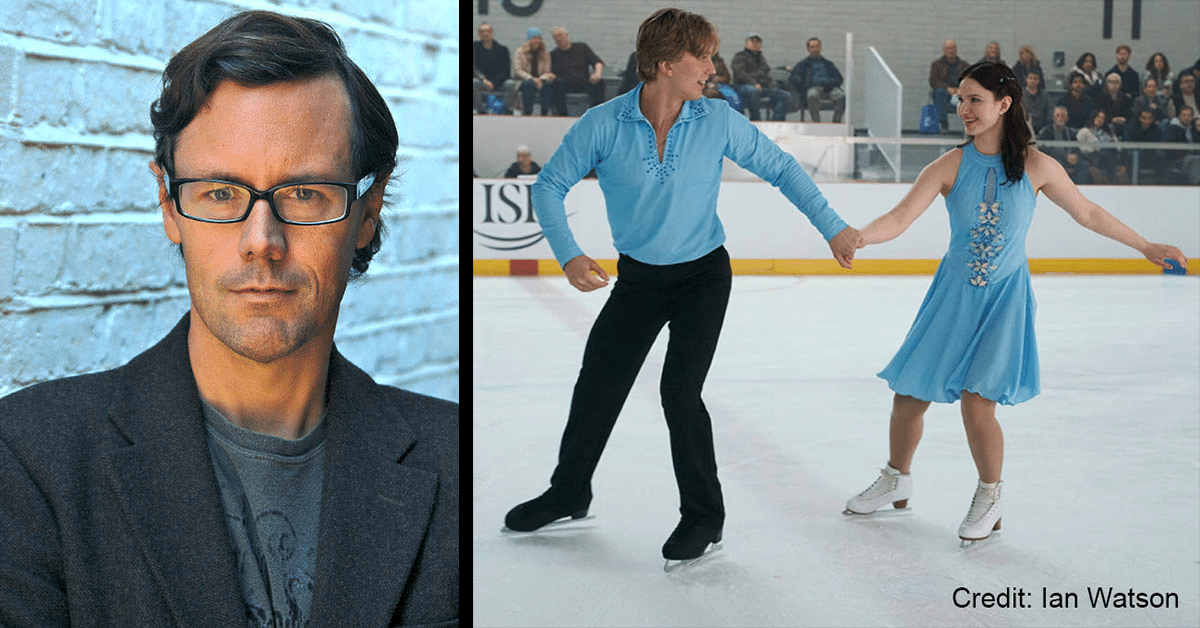
Jeff Norton shares with ScreenMDM his process for adapting Jennifer Iacopelli’s best-selling novel Finding Her Edge into a hit Netflix YA series that was quickly renewed for a second season after its launch in January.
Produced by WildBrain and set against the backdrop of competitive figure skating, season one landed in the English-language top ten in 81 markets, Netflix revealed in announcing the second season.
I caught up with Norton, the showrunner, about tapping into his novelist sensibilities, getting YA right, and the joys of reaching such a wide audience with the series.

I know the YA book space is very competitive. There’s an awful lot happening there in terms of adaptations. Give us a sense of the background of Finding Her Edge.
I come at the space as an author, a novelist. I also write television and produce and showrun, but my entry point is as a fellow author to people who’ve also written books. For me, that’s important because I feel as though one of the things I try to do is to honor what an author has put down on the page. To your point, it’s competitive to find books. I don’t have a checkbook the same way that a giant studio will have. But what I do have is a real respect and a real passion for honoring what somebody has spent years of their life, often on spec, writing in their book. I was lucky enough to get an early manuscript. It was an unedited PDF when I first was exposed to this book. Because I’m an author, I am friendly with people in the publishing world, and I’m often able to get an early look at projects. I always wanted to try to do something in the world of figure skating. I grew up in Canada, and my sister figure-skated when we were children. I played hockey very badly as a kid, but ice is part of your life when you’re growing up in Canada. It was something that I’ve already been pre-programmed to be interested in.
I’m always looking in this young adult space for stories that bring the audience into a subculture they may not have seen before. Geek Girl is very character-driven, but it also brings Harriet, the lead character, into the subculture of high fashion. And when I read Jennifer’s book, I not only fell in love with the characters, but I really loved the world that she had created, which, of course, was a fictional reflection of the real world of ice dance and competitive figure skating, but it was a fully formed world. I thought, that’s somewhere I’d love to spend some time.
Were you already preparing for a second season when you were working on the first? Renewals are hard today, right? It’s tough to get that second season!
When you’re deep in the process of either writing or, in my case, writing and then making the show, all you’re focused on is delivering the very best possible first season. I always tell myself that the best way to get a second season is to have a wonderful first season. So, you don’t want to be too clever about it in terms of trying to engineer what could happen later. We had a very small writing team. There are only four of us. Sometimes there was an instinct to say, ‘Oh, that would be fun to leave for a season two or a season three.’ And I kept saying to the team, ‘no, no, leave it all on the ice, because we may not get it so, but let’s make sure we’ve got all of the drama, all of the twists, all of the turns.’ That made for a really compelling, dramatic roller coaster that the audience reacted to, and then necessitated a second season. But I can tell you two things. The first is that after we wrapped in Paris, I was so inspired, I started writing on the plane ride back. And second, we were hopeful that the audience would fall in love with the characters, so we very deliberately put that fun twist at the end of episode eight, which leaves the door open for a really fun season two.
You’ve got to speak to an audience that’s anywhere from 16 to 40, right? How do you navigate writing for such a wide audience?
I don’t really think of YA as a genre. I think of it more as a point of view—I think of it as writing for anyone age 8 to 88. My guiding principle is the way that Pixar creates their stories, which is that there’s an entry point for everybody, and it’s the kind of show that has an opportunity for a very, very broad audience. I firmly believe that you have multiple opportunities to connect with YA, because you’ve got the slightly younger viewers that will watch up. You’ve got the demographic that’s roughly reflected in our characters’ ages and stages, so hopefully they will relate. And then you’ve got this magical thing that a lot of broadcasters don’t really acknowledge, which is that on one hand, the adult audience can remember very viscerally what it was like to be that age. And secondly, and this is the thing that nobody talks about—the magic with this point of view is that even if you’re age 30, 40, 50, 60, everybody is still coming of age. Everybody is still figuring out their life. I have yet to meet somebody, if they’re being really honest, who feels like they’ve figured out their life. And I think that’s the magic of YA stories, both in fiction and in television, is that everybody can relate to that feeling of not knowing what to do next. It’s hyper fixated in the teen years, because you don’t yet have the benefit of long-term perspective, because you’re only 17.
How are you looking at keeping up engagement with these characters in the time between seasons?
It’s certainly a practical challenge. For me, it comes down fundamentally to character. If you craft these characters to be compelling and interesting to the audience, they will come back. And I’m very aware that there’s a bifurcation of attention span. It’s very easy to think that a younger audience only wants to consume things on their phone or vertical drama with one minute swipes, and yet at the same time, that’s the same audience that will be absolutely compelled over 44 minutes of a linear story that’s drawn out in a way that is very deliberate and is very intelligent about its storytelling structure. I’m also very aware of turning the cards right. I give little twists probably every seven minutes or so, but that’s also very reflective, metaphorically, of the teenage experience. Things are constantly changing. Your friendships are shifting. You don’t know where you stand with your boyfriend or your girlfriend. So, part of that storytelling technique is actually reflective of what it means to be a teenager, but I do think fundamentally, it’s really about character, and people will come for the characters.
Canada is having a little bit of a moment right now. What do you think needs to be done to sustain momentum for Canadian content?
I’ve spent most of my career in the U.K. Although I’m Canadian, I’m also British, and I’ve spent most of my formative, creative years in the U.K. The Canadian system works at its best when it’s more reflective of the British system than the American system. And what I mean by that is, in the British creative ecosystem, it’s really about backing a singular voice for a show. So in the case of Heated Rivalry, Jacob Tierney wrote all six episodes, and he directed them. There was a singular vision for that show. On Finding Her Edge. I was lucky enough to have a small writer’s room, but fundamentally, I had a very specific, singular vision. I called it “timeless romance,” and I judged every decision I had to make in making the show, whether it’s a piece of wardrobe or a piece of music, the casting, every single one of those thousands and thousands of decisions, on whether that belonged to the show or not. And that’s because I come from the British system, and I think that’s where Canada can punch well above its weight. We may not be able to compete on spectacle or budget, but I think we can compete on voice and vision.
Do you have enough material to draw from the book for the second season? How much more are you having to create a wider universe as you continue to tell the story of these characters?
I looked at the initial character set and the initial setup from Jennifer’s amazing book, but we took the story in a different trajectory from what’s in the novel. The plot is different. What I had to do was really build out our own world and our own universe that’s organic to the show, and there are little things that we populate in season one that will pay off in season two. As an example, there’s a rival rink in the world of the show, which is called Voltage, run by a character called Kevin, played by former Olympian Elvis Stojko, and we tee up several times through season one and pay it off in episode eight that he has bought the Russo rink business. In doing so, there’s already conflict and drama baked into what’s going to come. But I had to lay those breadcrumbs early in season one in order to give us the flexibility to have somewhere to go in season two.
Are you concerned that we’re just going to be inundated with winter-sports-themed dramas in the next year, because these shows have done so well?
I’m not worried because we have a very specific tone and we have very specific characters. But I do find it humorous that this industry often has a number of copycats. There’s a trend, and then everybody follows that trend, and twas ever thus. But my hope would be that the lessons that we as an industry learn aren’t to copy, but in fact, to always be finding something new and compelling and different to offer the audience. I think that was the lesson of Heated Rivalry; if you offer something with a singular voice and a very specific vision, that’s totally different, then people will flock to it. In any creative system, if you back voices who have something to say, then I think you get exceptional pieces of art coming to the audience.
Are there other things that you’ve got going on outside of writing the second season that you can tell me about?
I’m writing a new book. I try to get a couple of hours every morning of prose fiction writing. I’m currently in post-production as a non-writing executive producer on a show called Crew Girl. It’s also in the YA point of view, also a Netflix show, set in the world of rowing. And, of course, I’m deep in writing season two for Finding Her Edge.


