

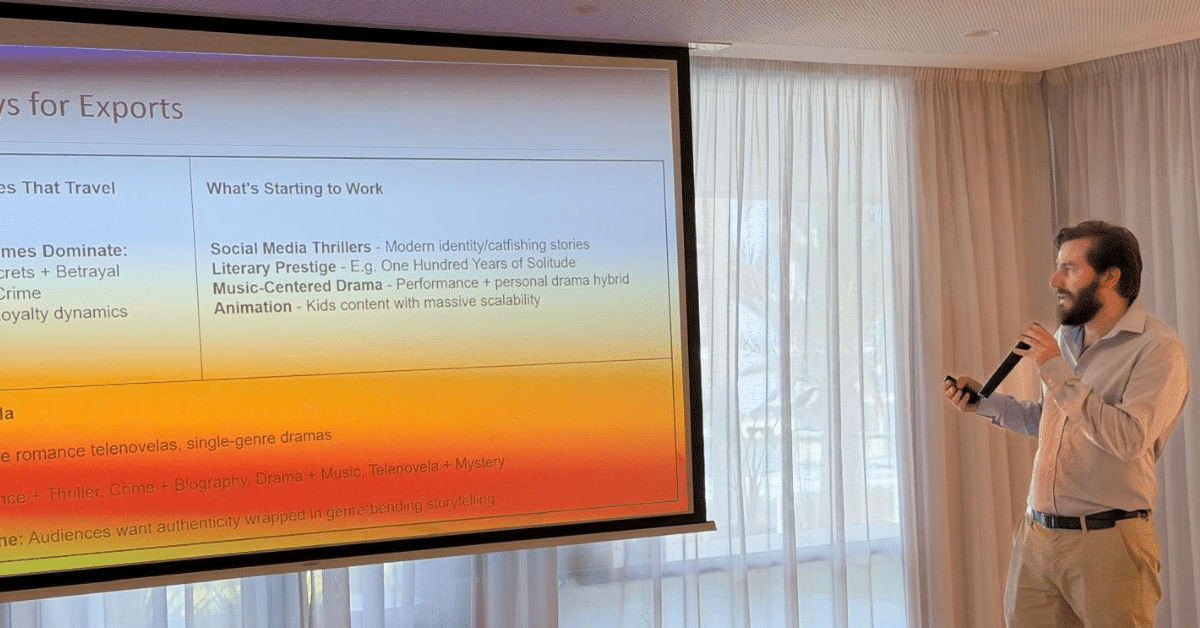
Jonathan Broughton, director of research at PlumResearch, delivered a keynote presentation on fiction and audience discovery at CONECTA in Mallorca, highlighting the streamer shift from a subscriber-acquisition mindset to a retention one.
Although global subscriber figures still appear healthy, net additions continue to decline steadily year after year. “Streaming services are maturing,” said Broughton. “They are no longer in the frantic growth mode they were in five or six years ago. That puts them today in a very strange position as they evolve from that past growth into this new mature model, and that is affecting their behavior.”


This scenario is forcing platforms to abandon the logic of “growth and marketing at any cost” in favor of “a more sustainable economic model.” Broughton defined this new logic as “subscriber management,” a concept that, he said, is completely transforming the strategic role of content within platforms.
“Content stops being simply an acquisition tool or a major commercial bet and becomes a sustainable retention infrastructure,” he said. For Broughton, streaming is moving away from mass programming toward far more specific, personalized, and niche-driven offerings. “For audiences, this transition means moving from mass programming toward something more targeted to them, something more niche, more specialized, perhaps more personal… a movement away from the search for the next big blockbuster toward understanding what is truly important to audiences within the platform,” he added.
According to Broughton, while traditional television operated under a “one-to-many” logic, streaming functions as a complex “many-to-many” network, where different layers of content fulfill completely different roles within the platform ecosystem. The “event layer” is made up of sports and major blockbusters designed to attract users; the “prestige layer” is aimed at building brand value; and the “habitual consumption layer” is the true engine of streaming stability. “It’s not necessarily the best content,” he emphasized. “It’s not content that has won many awards. It’s not even particularly new, but this is where most consumption happens… in this habit layer made up of older content.” According to Broughton, a large portion of platform consumption revolves around catalog titles, familiar series, and recurring programs that rarely generate public conversation or critical recognition.
According to PlumResearch data, the top 10 most-watched titles on platforms such as Netflix account for only 10 percent of total consumption, while the remaining 90 percent takes place across the broader catalog. “Within streaming, that broad library is much more important than it ever was in linear television,” Broughton stated, describing this dynamic as “the complete opposite” of traditional television.
Catalog content plays a fundamental role in what PlumResearch calls “reactivation,” meaning the process of preventing users from leaving the platform.
This new reality has led, according to Broughton, to the emergence of a new industry mantra: “Churn is the new acquisition.” The executive warned that reducing subscriber loss has become far more important than adding new users because of the enormous long-term economic value of each retained customer. “The average tenure of a Netflix subscriber is between six and eight years. So when somebody leaves the service, you are not losing one month of revenue. You are losing almost a decade of revenue,” he said.
Within this context, Broughton highlighted the enormous strategic value of niche audiences and highly loyal communities built around specific content. These “isolated audiences,” he explained, are users who consume virtually a single title within the platform. According to him, many of these niche series are “chronically undervalued,” with an estimated average loss “of around US$10 million per series.”
The keynote also addressed the rise of so-called “neo-evergreens,” licensed dramas, procedural series, and familiar titles such as Suits, Young Sheldon, and Supernatural, which function as comfort viewing or recurring-consumption content. According to Broughton, this type of programming represents “70% of everything being watched” on streaming platforms. “These are old shows that people discovered, recommended to friends, or simply want to watch again for the sixth or seventh time,” he explained.