

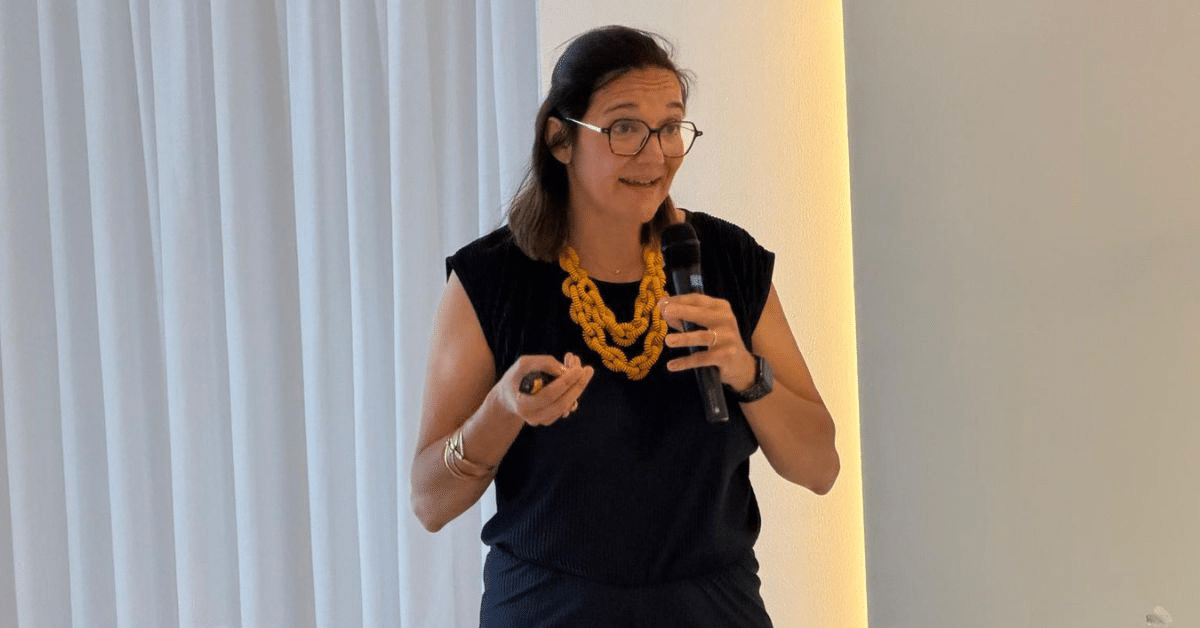
Speaking at CONECTA Magaluf-Mallorca, Caroline Servy, managing director of The WIT, discussed how the creator economy and traditional media are becoming increasingly intertwined.
The presentation, The Future of Entertainment: A Strategic Vision, leveraged The WIT’s storied database, which now includes an entire section to help subscribers discover YouTube content.
One of the central pillars of the presentation was the maturation of the creator economy and its growing challenge to traditional broadcasters. The executive highlighted YouTube’s “watch with” feature as a significant development that allows creators to comment on, co-host and enrich the streaming experience for their audiences. According to Servy, this means that each creator can become a media outlet around an event, offering more immersive, personal and emotional experiences for their communities. Servy argued that this represents an important change that broadcasters will potentially have to deal with during every major live events, since there are now as many additional channels as there are available content creators.
This rivalry is particularly visible in sports, especially in Brazil, where Servy noted that CazéTV is challenging TV Globo’s historic dominance by streaming major football matches to its 25 million subscribers. Servy explained that, in an age of infinite content, immediacy, real-time conversation and a sense of urgency have become key assets within the audiovisual ecosystem. She also argued that creators possess an energy and authenticity that traditional media struggle to replicate.
The relationship between creators and traditional distributors is also evolving through digital-native formats that later migrate to television. Servy observed that distributors could begin embracing this reverse logic more strongly, considering entertainment originally created by digital creators as a possible source for the future of formats.
Beyond the creator economy, the industry is also increasingly focused on scalability, Servy explained. More than ever, commissioning executives are seeking proposals adaptable to different budgets and programming needs, capable of connecting effectively with different audiences and functioning in a versatile manner across multiple platforms. This has generated growing convergence between linear television and digital platforms, as seen in the 24/7 live version of the reality show MasterChef in Mexico, which includes live cooking classes led by digital creators.
Addressing market data, Servy questioned the idea of a television industry in decline. She said it would be more accurate to speak of a “new normal,” in which commissioning volumes still remain above pre-COVID levels. While unscripted content premieres have grown since 2018, new format adaptations are showing signs of slowdown, but returning seasons continue to increase. Servy suggested that the industry could be entering a new stage in which formats remain a fundamental pillar of programming, although not necessarily the primary driver of disruptive innovation.
Western Europe continues to be the market most driven by formats, representing close to 48 percent of format adaptations worldwide. Spain was identified as one of the strongest leaders in this strategy, combining local and imported formats within its prime-time programming. Global streamers are also showing growing interest in local original formats that do not originate from the United States, such as The Traitors.
Servy warned about a slowdown in the emergence of new exportable formats. She said commissioners are becoming increasingly risk-averse due to the difficulty of finding new programs capable of generating major linear ratings, which turns completely new formats into riskier bets.
However, formats continue to be considered a relatively safe bet due to their renewal rates being higher than those of traditional unscripted programs. Servy also highlighted that, although the number of new ideas is decreasing, the number of hours dedicated to formats within schedules continues to grow steadily.
In closing her presentation, Servy argued that the industry appears to be heading toward a stage in which formats will continue to be a central component of television programming, although probably with fewer new titles, but more scalable and with the potential for multiple seasons. She also suggested that an important part of future innovation could increasingly come from outside the traditional media ecosystem.


