
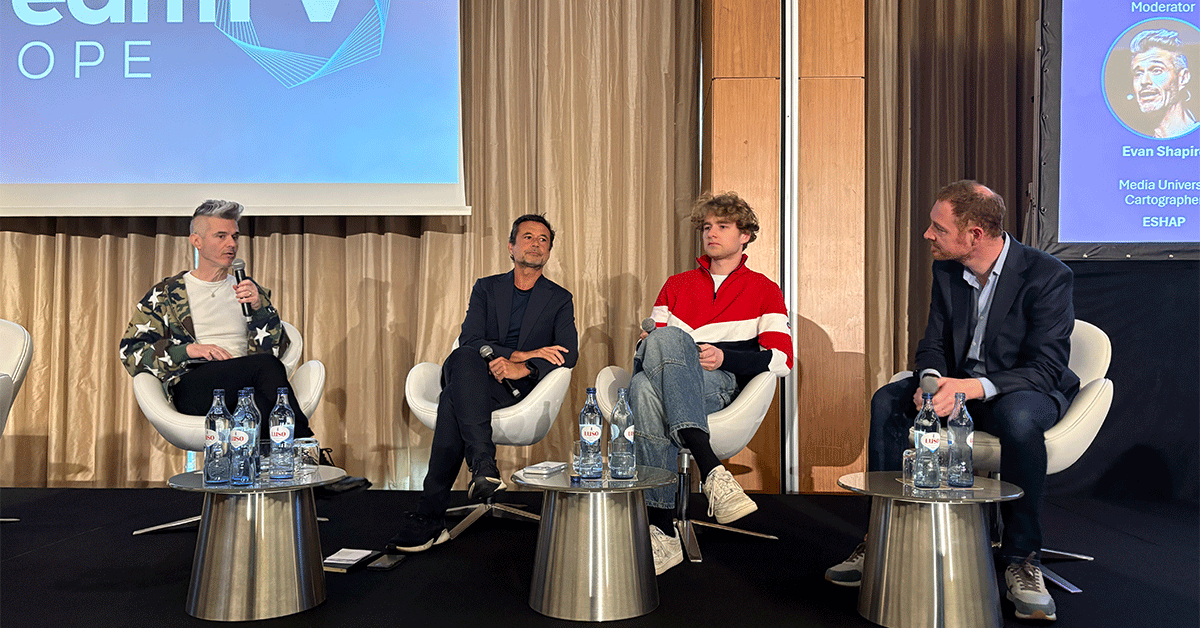
TF1’s Julien Laurent, content creator Gaspard Guermonprez, and YouTube’s Pedro Pina gave StreamTV Europe delegates a masterclass on how legacy free-to-air broadcasters can use social video to engage younger audiences with news content, in a session moderated by Evan Shapiro.
Guermonprez was just 10 years old when he started a YouTube channel; 18 years later, he is among France’s most popular content creators and is charting a new path with TF1 to engage young audiences with insightful news content in the run-up to the 2027 French election. Guermonprez, Laurent, and Pina weighed in on the question of news, social video, and journalistic integrity at the StreamTV Europe panel yesterday.

Laurent is the chief digital officer at TF1, which has been embracing new platforms as it seeks to maintain its relevance with audiences across France, especially in news content. Authenticity has been critical in the process, Laurent explained. “We never wanted to mimic the creators somehow. We never wanted to cosplay them. We thought that was a way to harm a brand, harm the trust that people have in their news media.”
Guermonprez began his YouTube life by filming his Minecraft sessions, but with parents who traveled extensively for work, he became more interested in making videos to explain the world to his audience. He met Laurent at a YouTube-convened summit on news.
“Our focus is making sure we deliver the best content that people are looking for, that viewers are looking for,” said Pina, VP for Europe at YouTube. “Having a user-first perspective has always been what we want to do. So the content we deliver on YouTube is what people want to see. Gaspard said, ‘We believe that there’s a different way for us to deliver news. My generation needs a new language, a better understanding, or a different way to understand the news that is delivered. I’m going to deliver that to them. And sure enough, when you deliver to the viewers what they want, guess what happens? They love it, and that’s why he’s been so successful. TF1 is incredibly successful on YouTube. It has more than 60 YouTube channels, more than 2 billion views last year, and continues to grow tremendously. TF1 is one of the biggest believers in YouTube and invests heavily in it each year. They have also realized that there is an audience out there who is not benefiting from the great content it produces—the quality of news production on TF1 is among the best in Europe. However, there was an audience that was missed, and the reason was that it was born on YouTube. TF1 deserves the audience, and people like Gaspard understand the voice, the tone, and how that content needs to be delivered. TF1 understands how an incremental audience is generated. And Gaspard has the opportunity to be connected to a brand that has one of the highest levels of trust in news production in France.”
For TF1, embracing and understanding YouTube has been a journey, Laurent said. Just dropping content on the platform wasn’t enough. “We started to think our content needs to be more liquid—meaning they have to fit with multiple environments. We started creating our content in a streaming-first approach. With this idea, we must multiply the liquidity of the content so it can be throughout all those environments, for YouTube, for TikTok, for Snapchat, for TF1, for the news app, etc.”
For Laurent and Guermonprez, it does not mean short-form; “We do long-form content about investigations—slow journalism,” Guermonprez said. “It’s not about being the first only on the news, but being the most precise, the most rigorous about the words we use. Maybe my generation, Gen Z, is the most polarized. We try to create a balanced space.”
Shapiro asked Pina about whether the TF1 model is “the right way to do YouTube,” to which he responded: “Don’t worry about YouTube—worry about your viewer and what the viewer wants. YouTube is just a platform to deliver that. We have four types of formats you can use—long form, short form, podcasting, and live. You can put everything under one umbrella. We share the monetization with everybody. We provide the analytics. YouTube is just a platform. The one mistake that creators and other players make is the first question: how can I make money on YouTube? This is not about making money. This is about what you want to say and what viewers need to listen to what you have to say. If you do that, really, really well, the money will come.”
YouTube is working with 300-plus broadcasters and studios in Europe alone, Pina noted. “Those who succeed are the ones who are single-mindedly focused and obsessed with understanding the viewers. It’s not about shoving content into YouTube, hoping it gets reviewed. It’s actually about understanding how it will be viewed. And if you do that, then that’s the best way to do YouTube.”
The partnership with TF1 sees Guermonprez working on an interview format with the French media giant, Le Dossier, featuring conversations with political candidates, quizzing them on their own history by tapping into old social media posts and archive content.
“We have this font of content,” Laurent explained. “We could orchestrate the way we work together to create this content, find the relevant archives to match what we wanted to discover in this content. It’s a long-form, very slow news format. I mean, it is starting now, and the election is a year ahead, so we wanted to make content that’s going to last very long, and really that deconstructs the political DNA of all the candidates that we’re going to vote for, or not.”
“Each episode is like basically a content machine,” Guermonprez said. “We can create dozens and dozens of clips used on YouTube Shorts, of course, but also on TikTok and other platforms.”
Shapiro noted that the sweet spot for monetization of content on YouTube is actually 40 minutes—not short-form segments that the platform is known for. “There is a lot of mythology that gets created around YouTube or other platforms,” Pina said. “Oh, YouTube is just for young people. Actually, it isn’t. It is true that YouTube’s audience is younger than traditional broadcasters’, but it’s not just kids on skateboards anymore. People just refuse to see this, over and over again. There’s this idea that young people have no attention span. They spend all their time on TikTok. That’s not true. Gen Zers are the biggest consumers of podcasts and YouTube in the living room, on the big screen. Gen Zers listen to podcasts for more than 3 hours at a time. Yes, many people also consume short-form video in the living room, and one of the biggest growth drivers for Shorts is there. I strongly recommend that people actually look at the data. The data consistently shows things that differ from preconceived notions out there. As a platform, we empower creators with as many tools as possible to express themselves creatively in the best way they can. You have a canvas of opportunities.”
One of those tools is cross-channel collaboration, with Le Dossier appearing on both TF1 and Guermonprez’s YouTube channels.
“We launched the video five days ago, and some people watching TF1 Info subscribed to my channel,” Guermonprez said. “It’s also a way of multiplying the audience, converging the audience. There is a whole generation of people discovering my work with this collaboration.”
Laurent returned to his brilliant concept of content “liquidity” as he touted the benefits of Le Dossier. “It’s streaming first, it’s into multiple formats. It goes everywhere. It reaches millions of people. It goes on TV. It also goes on the morning news show. Our focus is not targeting young people or targeting old people. Our focus is to make great news content that reaches everybody.”
As the session wrapped, Pina weighed in on what YouTube and social video, in general, mean for the future of the news business. “There have been big questions about the future of news in the digital world. Was it sustainable? Would you find its audience? Could it be monetized? News is important for our livelihoods, for democracy, and for the future of nations. It’s important for citizenship. So, there was a big question of how the news would survive this digital wave. For me, this collaboration, bringing together the new and the old, the legacy, the trust, and the new voices, and finding a path forward, is incredibly encouraging, and it’s critical for us. It’s critical for us because it’s a huge source of audience for our viewers, which continues to be our obsession and our dedication. But more importantly, we need partners who are sustainable and financially sustainable, and who can grow in the future in the new space. And this, to me, feels like what the future is going to look like.”